Je T’Aime Meaning: The Real French Love Confession
You saw three words in a text message and now your whole afternoon is different. Maybe it was a lyric stuck in your head, or someone typed it into a DM and you stared at your phone like it might explain itself.
That’s exactly what this guide is for. Below, you’ll get the real je t’aime meaning, how it’s actually used, and what to say back when someone hands you those words. The secondary keyword here is the same phrasebecause honestly, that’s how often people search it. Keep reading, it gets clearer fast.
je t’aime meaning
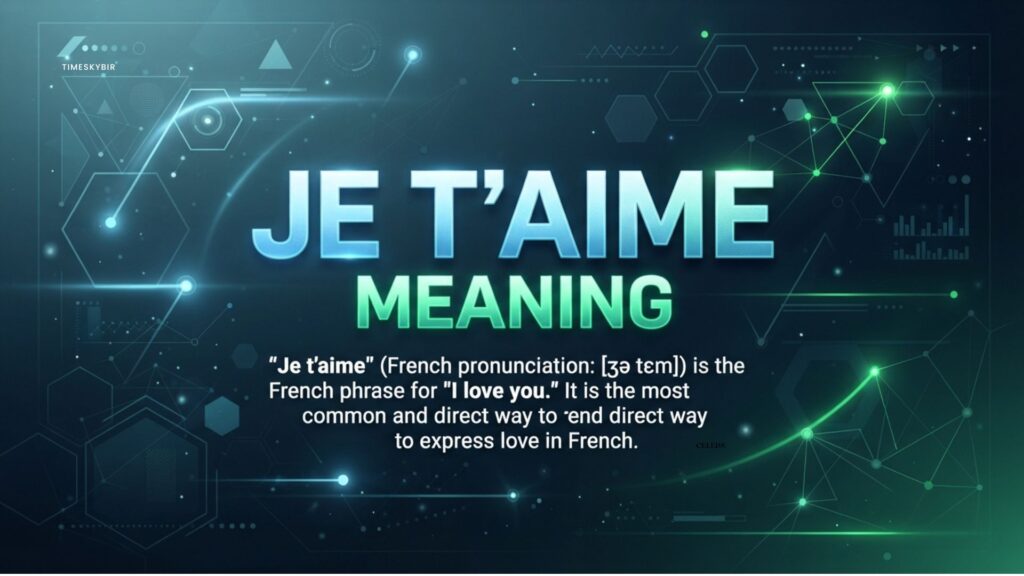
Three words, one huge emotional shiftthat’s the honest starting point before anything else makes sense here. The je t’aime meaning isn’t complicated on paper, but the feeling behind it is where people get stuck.
What Does Je T’Aime Actually Say?
- Translates directly to “I love you” in English
- Carries real romantic and emotional weight in French
- Rarely gets said casually by native French speakers
- Signals a genuine relationship milestone, not small talk
- Differs sharply from lighter phrases like je t’aime bien
- Works for romantic partners, parents, and close family
| Phrase | Literal Meaning | Emotional Weight |
| Je t’aime | I love you | Highserious, romantic |
| I love you (English) | I love you | Varies by context |
| Je t’aime bien | I like you | Lowfriendly only |
Example in texting: Friend 1: “He just said je t’aime???” Friend 2: “Girl. That’s not a casual thing to say.”
So Someone Said Je T’Aime to You
Getting this phrase out of nowhere is disorienting in the best way, and understanding je t’aime meaning right away helps you respond instead of just staring at your screen. The secondary keyword matters here too.
Why Does French Feel So Intense Even Before Translation?
- Sounds emotionally loaded even to non-French speakers
- Lands differently than the English equivalent somehow
- Feels intentional, rarely accidental or thrown around
- Suggests the person chose their words carefully
- Implies they wanted something to feel weightier
Example in chat: Friend 1: “he said je t’aime in his last message” Friend 2: “okay but do YOU feel it back though”
What Makes This Phrase Different From “I Love You”
English lets “I love you” stretch toward friends, pets, and pizza without losing meaning, but French treats je t’aime meaning with far more caution and intention. That gap explains a lot of confusion.
Is French “I Love You” More Serious Than English?
- Reserved almost entirely for real emotional attachment
- Avoided casually, unlike English’s flexible usage
- Treated as a genuine turning point in a relationship
- Spoken less frequently, which increases its impact
- Understood by French speakers as a real commitment word
- Rarely said just to fill silence or awkwardness
Example in texting: Friend 1: “french people really don’t say it unless they mean it” Friend 2: “yeah that’s the whole point honestly”
The One Difference That Trips Everyone Up
Most guides skip this, but the gap between two nearly identical phrases changes the entire je t’aime meaning conversation, and it’s the single biggest source of real confusion out there.
Does Adding “Bien” Make Je T’Aime Stronger?
- Reduces the intensity instead of boosting it
- Signals fondness, not romantic love or attraction
- Confuses English speakers who assume “bien” adds emphasis
- Pulls back emotionally rather than leaning further in
- Means “I’m fond of you,” closer to friendship
- Requires careful listening so you don’t misread the moment
| Phrase | Meaning | Romantic? |
| Je t’aime | I love you | Yes |
| Je t’aime bien | I like/am fond of you | No |
Example in chat: Friend 1: “she said je t’aime bien not je t’aime” Friend 2: “oh no that’s the friend zone version”
Je T’Aime vs Je T’Adore: Which One Means More?
People assume “adore” always outranks “love,” but French doesn’t quite work that way, and knowing this keeps your understanding of je t’aime meaning accurate instead of guessed.
Which Phrase Carries More Weight, Aime or Adore?
- Je t’aime carries the heaviest, most serious tone
- Je t’adore feels affectionate but noticeably lighter
- Adore works for friends, food, or hobbies too
- Aime stays reserved almost strictly for real love
- Context decides which phrase actually fits the moment
| Phrase | Feels Like | Common Use |
| Je t’aime | Deep romantic love | Partners, close family |
| Je t’adore | Strong affection | Friends, casual love |
Example in texting: Friend 1: “he said je t’adore not je t’aime” Friend 2: “cute but not the same league lol”
How Je T’Aime Actually Shows Up in Real Conversations
Reading definitions is one thing, but seeing je t’aime meaning play out in texts, captions, and real messages makes the phrase click in a way no dictionary entry manages to do.
What Do Real Je T’Aime Text Messages Look Like?
- Appears in late-night texts before goodnight
- Shows up in anniversary captions and photo posts
- Gets used playfully between close friends sometimes
- Softens honesty, as in “je t’aime bien, mais pas comme ça”
- Signals sincerity far more than casual slang would
- Rarely appears mid-argument or as filler text
Example in texting: Friend 1: “je t’aime. sleep well” Friend 2: “did you just say you love me in french”
What Does Je T’Aime Literally Translate To?
People searching this want a clean, direct answer, and honestly, the je t’aime meaning is simpler than the emotional weight around it suggests once you break down each word.
Breaking Down Each Word in Je T’Aime
- Je translates simply to “I” in English
- T’ is a contraction of “te,” meaning “you”
- Aime comes from “aimer,” the verb “to love”
- Together they form the literal phrase “I love you”
- Nothing hidden or symbolicit’s a direct translation
Example in chat: Friend 1: “wait what does je t’aime literally mean” Friend 2: “it’s just I love you, word for word basically”
How to Reply on Je T’Aime
Freezing up after hearing this phrase is common, but there’s a natural, low-pressure way to respond that fits the je t’aime meaning without forcing feelings you don’t have yet.
What’s the Correct Way to Say I Love You Too?
- Je t’aime aussi means “I love you too” exactly
- Aussi simply translates to “too” or “also”
- Feels natural as the expected romantic reply
- Doesn’t require you to reply in French at all
- Works better honestly, in your own language, if unsure
- Skips pressure to match words you don’t yet mean
Example in texting: Friend 1: “je t’aime” Friend 2: “je t’aime aussi 🤍”
Je T’Aime Pronunciation (So You Don’t Butcher It)
Saying this phrase out loud feels intimidating, but the je t’aime meaning stays intact even with an imperfect accent, since French speakers appreciate the effort more than perfection.
How Do You Pronounce Je T’Aime Correctly?
- Sounds roughly like “zhuh tem” when spoken
- Softens the “je” into a quiet “zhuh” sound
- Blends “t’aime” quickly into almost one syllable
- Avoids a hard or sharp ending sound
- Works best said gently, not overly dramatic
Example in chat: Friend 1: “how do you even say je t’aime” Friend 2: “zhuh tem, kinda soft and quick”
Je T’Aime Related Phrases Worth Knowing
Once you understand the core je t’aime meaning, a handful of related phrases round out your vocabulary and help you avoid mixing up tone in real conversations.
What Are Common Phrases Related to Je T’Aime?
- Je t’aime aussi replies with “I love you too”
- Je t’aime bien softens things to friendly fondness
- Que je t’aime adds poetic, lyrical emphasis
- Je t’adore expresses lighter, affectionate love
- Mon amour means “my love,” a term of endearment
- Je t’aime fort intensifies to “I love you fiercely”
| Phrase | Meaning | Where You’ll Hear It |
| Je t’aime aussi | I love you too | Replying to je t’aime |
| Je t’aime bien | I like/am fond of you | Warm, non-romantic contexts |
| Que je t’aime | How I love you | Songs, poetry, literature |
| Je t’adore | I adore you | Affectionate, lighter tone |
Example in texting: Friend 1: “que je t’aime just hits different in songs” Friend 2: “right it’s so much more poetic than just je t’aime”
The History Behind Je T’Aime in French Culture
Understanding where a phrase comes from adds real context, and the je t’aime meaning has roots in a culture that treats verbal love confessions with unusual seriousness.
Why Is French Culture So Careful With Saying I Love You?
- Reflects a broader French value of emotional restraint
- Traces back to older romantic and literary traditions
- Appears heavily in classic French poetry and song
- Contrasts with more expressive, casual English habits
- Stays tied to genuine, considered relationship moments
Example in chat: Friend 1: “french people take je t’aime way more seriously than we do” Friend 2: “yeah it’s basically saved for when they truly mean it”
Is Je T’Aime Only for Romantic Love?
A common misconception limits the je t’aime meaning to couples only, but French families and close friends use this phrase in ways that deserve just as much attention.
Can Parents and Family Use Je T’Aime Too?
- Used naturally between French parents and children
- Spoken between siblings and close relatives often
- Carries unconditional warmth in a family context
- Stays genuine, not diluted by frequent casual use
- Differs slightly in tone from romantic usage
- Appears on social media toward close friends sometimes
Example in texting: Friend 1: “my french host mom says je t’aime to her kids all the time” Friend 2: “aw that’s actually really sweet honestly”
Is It Too Soon to Say Je T’Aime in a Relationship?
Timing questions come up constantly, and while the je t’aime meaning never changes, when you say it absolutely does, especially early in a new relationship.
When Should You First Say Je T’Aime to a Partner?
- Wait until feelings feel genuinely established, not rushed
- Notice if actions already show commitment beforehand
- Avoid saying it just to match a partner’s words
- Trust that French speakers rarely say it lightly
- Remember timing matters more than translation ever does
Example in chat: Friend 1: “is it too early to say je t’aime after two months” Friend 2: “only you know that honestly, but don’t rush it”
Why People Search “Je T’Aime Meaning in Spanish”
This search confuses a lot of people, and clearing it up matters because the je t’aime meaning actually belongs to French, not Spanish, despite similar-sounding romance vocabulary.
Is Je T’Aime a Spanish or French Phrase?
- Belongs entirely to French, not Spanish
- Sounds vaguely similar due to shared Romance roots
- Confuses learners studying multiple Romance languages at once
- Matches the Spanish phrase “te amo” in weight
- Compares loosely to “te quiero” for broader affection
| Language | Phrase | Meaning |
| French | Je t’aime | I love you |
| Spanish | Te amo | I love you (romantic) |
| Spanish | Te quiero | I love/care for you |
Example in texting: Friend 1: “wait is je t’aime spanish or french” Friend 2: “french! te amo is the spanish version”
Je T’Aime in Songs, Movies, and Pop Culture
Pop culture spread this phrase far beyond French speakers, and that exposure shaped how people casually understand the je t’aime meaning today, sometimes stripping away its original weight.
Why Do So Many Songs Use Je T’Aime?
- Fits naturally into romantic, poetic songwriting
- Sounds melodic and emotionally rich when sung
- Appears across decades of French and international music
- Gets used in captions to sound romantic or aesthetic
- Loses some seriousness through casual online repetition
Example in chat: Friend 1: “half the songs I like just randomly drop je t’aime” Friend 2: “it sounds so much more romantic than english honestly”
When Je T’Aime Gets Misread
Translation almost never causes the real problem heretone does, and misunderstanding that gap is where the je t’aime meaning gets lost between cultures and platforms most often.
Why Do People Misunderstand Je T’Aime Online?
- Uses the phrase as aesthetic shorthand, not confession
- Appears in captions without deep romantic intent
- Dilutes perceived seriousness for non-French speakers
- Confuses casual online use with genuine declarations
- Requires context to know which meaning applies
Example in texting: Friend 1: “she comments je t’aime under literally every post” Friend 2: “that’s just aesthetic, not a love confession lol”
Do French People Say Je T’Aime Often?
This question comes up constantly, and answering it honestly protects the entire je t’aime meaning from being flattened into something as casual as its English counterpart.
How Often Do French Speakers Actually Say I Love You?
- Says it far less frequently than English speakers do
- Reserves it for meaningful, considered moments
- Avoids overusing it to keep the phrase impactful
- Chooses actions over words in daily affection often
- Treats frequent use as diminishing its emotional value
Example in chat: Friend 1: “do french couples say je t’aime every day” Friend 2: “not really, they kind of save it on purpose”
Common Mistakes Non-French Speakers Make With Je T’Aime
Getting the words right isn’t the hard partmisreading tone is, and most mistakes around je t’aime meaning come from applying English habits to a French emotional context.
What Are the Biggest Je T’Aime Mistakes to Avoid?
- Confusing je t’aime with je t’aime bien
- Saying it too soon to seem romantic or poetic
- Assuming it’s Spanish instead of French
- Overusing it casually the way English allows
- Ignoring tone and treating it as pure vocabulary
- Skipping pronunciation practice before saying it aloud
Example in texting: Friend 1: “I almost said je t’aime bien thinking it meant more” Friend 2: “glad you checked first, that would’ve been awkward”
Real Questions People Actually Have?
What does je t’aime aussi mean?
It means “I love you too,” the natural reply to je t’aime. Aussi simply translates to “also” or “too.”
What does que je t’aime mean?
It means “how I love you,” a poetic, expressive form. It appears more in French songs than everyday speech.
Is je t’aime used for family or just romance?
Both. French parents and siblings use it genuinely, alongside romantic partners in relationships.
How is je t’aime different from je t’aime bien?
Je t’aime signals romantic love, while je t’aime bien signals fondness without romance. Adding “bien” softens, not intensifies.
Can you say je t’aime to a friend?
Yes, though French speakers use it more carefully than English speakers use “love you” casually.
Is je t’aime formal or casual?
It’s neither strictly formal nor casualit’s emotionally serious, reserved for genuine feelings and real moments.
What’s the real difference between je t’aime and I love you?
The je t’aime meaning stays similar, but French speakers say it far less casually than English speakers say “I love you.”
Conclusion
At its core, the je t’aime meaning is simple: it’s French for “I love you,” spoken with real emotional weight behind it. It isn’t tossed around casually, and that restraint is exactly what makes it land so hard when someone says it to you directly.
Remember the key distinctions covered hereje t’aime versus je t’aime bien, and how je t’aime aussi works as the natural reply. The je t’aime meaning shifts slightly depending on who’s speaking, whether it’s a partner, a parent, or a close friend, but the sincerity behind it rarely does.
So next time those three words show up in a text, a caption, or a quiet momentyou’ll know exactly what you’re holding, and exactly how to hold it back.

Samuel Prescott explores Bible meanings, biblical names, and scripture insights, helping readers uncover deeper faith and understanding.