

Scientific Words That Start With T: 200+ List
Ever hit a wall in the middle of a science chapter because one term just wouldn’t click? You know it’s technical, you can tell it matters, but the actual meaning stays just out of reach and suddenly the whole page feels harder than it should.
This guide fixes that completely. You’ll find every major entry among scientific words that start with t, sorted by subject, grade level, and difficulty, with plain-English definitions and real examples that actually stick. Whether you’re cramming for an exam or just curious about a science word for t, everything’s organized right below keep scrolling and it’ll click fast.
scientific words that start with t
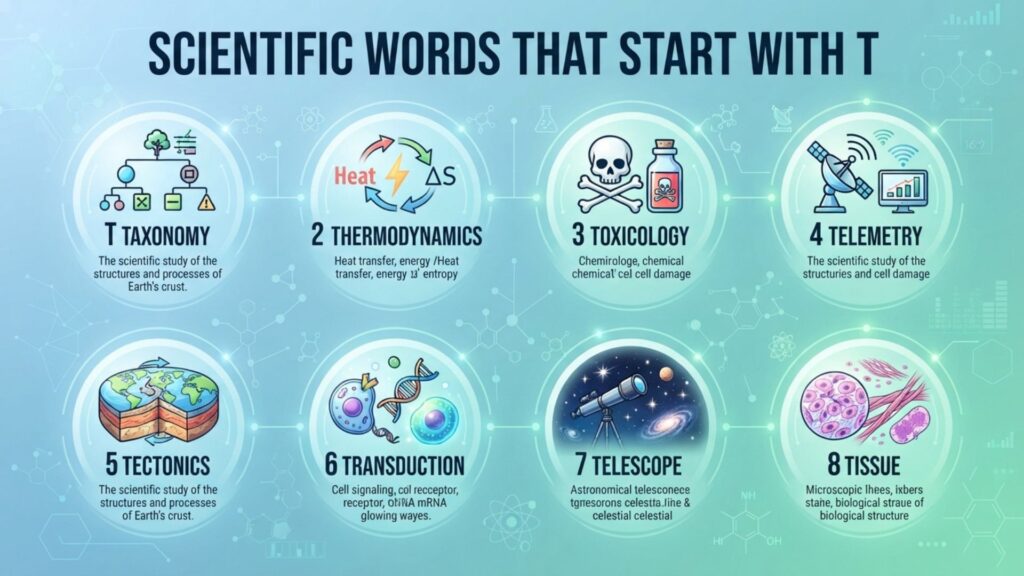
At the core, scientific words that start with t span physics, chemistry, biology, earth science, and medicine terms like tectonic, transpiration, thermodynamics, and tissue. A huge share trace back to Latin and Greek roots, especially “trans-” (across), “tri-” (three), and “thermo-” (heat), which is exactly why this letter produces such a long list across every discipline.
Once that pattern clicks, unfamiliar vocabulary gets a lot easier to decode. Recognizing a shared root turns memorization into pattern recognition, which sticks far longer than repetition alone.
science word for t
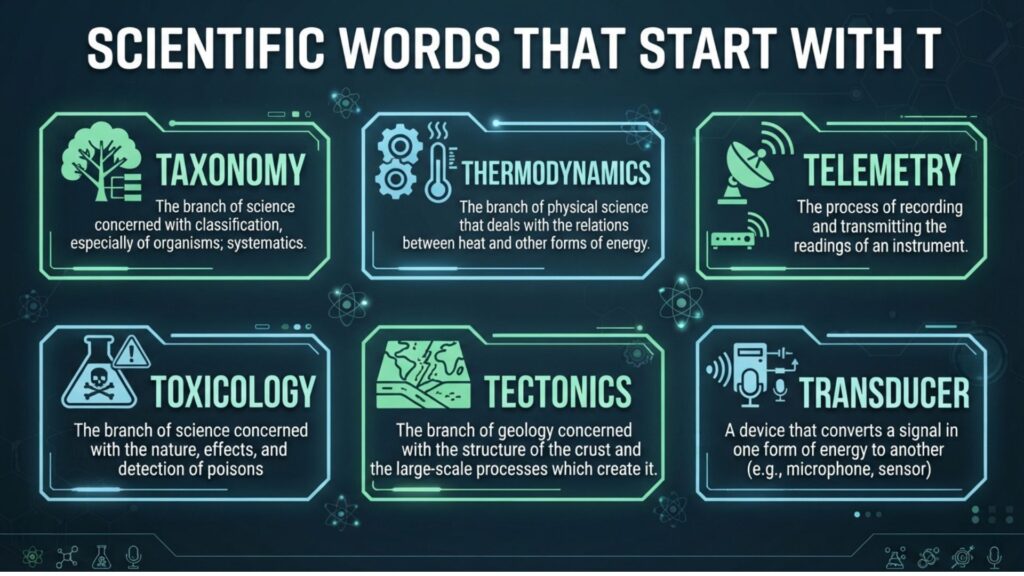
Need just one solid example of a science word for t? Thermodynamics is a strong starting point because it explains something everyone already experiences: how heat and energy move. Every engine ever built, from a car to a jet turbine, runs on its principles.
Other reliable single examples include tectonic (Earth’s crustal plate movement), tissue (a group of similar cells working together), and transpiration (water vapor released through plant leaves).
science words for t
Science words for t cluster heavily around a handful of shared roots. “Trans-” gives us transcription, translation, and transpiration. “Thermo-” gives us thermodynamics, thermostat, and thermocline. “Tri-” gives us triple bond and trimester.
Once you spot these families, a dozen unfamiliar terms suddenly make a lot more sense, since the root does most of the explaining before you even reach the full definition.
science words that start with the letter t
Looking for science words that start with the letter t tied specifically to classroom learning? These are the terms teachers test on most temperature, tissue, tectonic, trait, trachea vocabulary that shows up in nearly every grade-school science curriculum at some point.
Once these basics are locked in, moving into subject-specific terms like thylakoid or triage becomes much easier, since a lot of the underlying logic carries over.
science things that start with t
Beyond strict vocabulary, plenty of science things that start with t show up constantly in everyday life a thermometer on your wall, a thermostat controlling your house, a tsunami warning on the news, a transistor inside your phone. These aren’t just textbook words; they’re the science quietly running in the background of daily life.
20 Most-Used Science Words That Start With T
Short on time before a quiz? Here’s a fast-access table covering the scientific words that start with t that appear most often across subjects and grade levels.
| Word | Quick Definition |
| Temperature | Measure of heat energy in a substance |
| Tissue | Group of similar cells working together |
| Tectonic | Related to movement of Earth’s crustal plates |
| Transpiration | Water vapor released through plant leaves |
| Toxin | Poisonous substance produced by living things |
| Thermal | Related to heat or temperature |
| Taxonomy | Science of classifying living organisms |
| Tendon | Tissue connecting muscle to bone |
| Trajectory | Path of a moving object through space |
| Transformer | Device that changes electrical voltage |
| Tide | Rise and fall of sea levels caused by gravity |
| Thorax | Middle body section of insects; chest in humans |
| Turbine | Machine converting fluid motion into energy |
| Troposphere | Lowest layer of Earth’s atmosphere |
| Trait | Inherited characteristic of an organism |
| Translucent | Allows partial light passage |
| Trachea | Airway tube connecting mouth to lungs |
| Tsunami | Large ocean wave caused by seismic activity |
| Thermostat | Device that regulates temperature automatically |
| Titration | Lab method measuring concentration of a solution |
Learn this table first it covers close to everything a standard middle or high school test asks about science words for t.
Physics Science Words That Start With T
Physics covers matter, energy, and forces, and its T-vocabulary shows up whether you’re studying motion, sound, light, or electricity.
Tension A pulling force stretching an object. Pull both ends of a rubber band and you feel it immediately.
Thermodynamics The study of heat and energy transfer. Every engine ever built runs on these principles.
Torque A twisting force causing rotation, at work whenever you turn a doorknob or tighten a bolt.
Transverse wave A wave where particles move perpendicular to the direction of travel; light behaves this way.
Turbulence Chaotic, irregular fluid or air movement, felt by airplane passengers during rough flights.
Terminal velocity The maximum speed a falling object reaches when air resistance equals gravity, the exact point skydivers hit during freefall.
Time dilation Time slowing down at high speeds or in strong gravity, a core prediction of Einstein’s relativity.
| Physics Word | Why It Matters |
| Tension | Explains stretching and pulling forces |
| Thermodynamics | Foundation of engines and energy transfer |
| Terminal velocity | Explains freefall and air resistance |
| Time dilation | Core concept in special relativity |
Chemistry Science Words That Start With T
Chemistry deals with atoms, bonds, and reactions, and several frequently searched science words that start with the letter t live here.
Titration A lab method measuring solution concentration, used in food testing, water quality labs, and pharmaceutical manufacturing.
Transition metal Elements in the periodic table’s middle block iron, copper, nickel known for variable oxidation states and colorful compounds.
Thermite Aluminum powder mixed with iron oxide, burning at extreme temperatures and used in welding and controlled demolition.
Triple bond Three shared electron pairs between two atoms; nitrogen gas contains one.
Tyndall effect Light scattering by particles in a colloid, the reason a sunbeam through dusty air becomes visible.
Toxicology The study of how chemicals affect living organisms, and at what doses they become harmful.
| Chemistry Word | Example |
| Titration | Measuring exact solution concentration |
| Thermite | Welding and controlled demolition |
| Triple bond | Nitrogen gas (N₂) molecular structure |
| Tyndall effect | Visible sunbeams through dusty air |
Biology Science Words That Start With T
Biology’s T-words span cells, organs, ecosystems, and genetics, and they show up constantly across every level of coursework.
Taxonomy Groups life into a nested hierarchy: domain, kingdom, phylum, class, order, family, genus, species, a framework built by Carl Linnaeus in the 1700s.
Transpiration Water vapor released through plant leaves, driving a continuous upward pull. A single large tree can move 400 liters of water daily this way.
Trophic level Position in a food chain, with energy dropping roughly 90% between each level as it moves upward.
Turgor pressure Water pressure inside plant cells that keeps stems upright. When plants lose it, they visibly wilt which is why watering a drooping plant revives it within hours.
T-cells White blood cells central to adaptive immunity; some attack infected cells directly, while others coordinate the broader immune response.
Telomere Protective chromosome caps that shorten with each cell division, studied as a biological clock for aging.
Transcription DNA copied into messenger RNA inside the nucleus, the first step in making any protein.
| Biology Word | Real-World Connection |
| Taxonomy | Classifying all living organisms |
| Transpiration | Water movement through plants |
| T-cells | Immune system defense |
| Telomere | Cellular aging research |
Earth Science Words That Start With T
Earth science covers rocks, weather, and coastlines, and several important science things that start with t live in this category.
Tectonic (plates) Earth’s crustal plates move a few centimeters per year, about the rate your fingernails grow, yet that slow movement builds mountain ranges and triggers earthquakes.
Tsunami Barely noticeable in deep ocean, sometimes only 30 centimeters tall, but capable of rising 30 meters at the shore as the wave shallows.
Tropopause The sharp boundary between the troposphere and stratosphere, where commercial aircraft cruise just below to avoid weather.
Tundra A cold, treeless biome with permafrost beneath a thin soil layer, ecologically fragile despite very low biodiversity.
Tornado A rotating air column reaching the ground from a thunderstorm, rated on the Enhanced Fujita scale from EF0 to EF5.
Thermocline A layer where water temperature drops sharply with depth, staying near-constant and cold below that point.
| Earth Science Word | Why It Matters |
| Tectonic | Explains earthquakes and mountain formation |
| Tsunami | Coastal hazard from seismic activity |
| Tundra | Fragile Arctic and high-altitude biome |
| Tornado | Rated and tracked using the EF scale |
Space & Astronomy Science Words That Start With T
Astronomy borrows several T-words to describe scale, structure, and the mechanics of space.
Telescope Collects light or other radiation from distant objects. The James Webb Space Telescope detects infrared light from galaxies formed a few hundred million years after the Big Bang.
Tidal locking A moon rotating at the same rate it orbits, permanently showing one face. Earth’s Moon is tidally locked its far side is never visible from Earth’s surface.
Transit (astronomy) A smaller body crossing in front of a larger one; astronomers detected most known exoplanets by measuring the tiny brightness dip during a stellar transit.
Terrestrial planet A rocky, dense planet. Mercury, Venus, Earth, and Mars are the solar system’s four.
Total solar eclipse The Moon fully covering the Sun’s disk, briefly revealing the faint outer corona not visible otherwise.
Thermosphere An atmospheric layer from 80 to 600 kilometers altitude, where temperatures can exceed 2,000°C even though the air is too thin to transfer much heat.
Medical & Health Science Words That Start With T
Doctors and medical staff rely heavily on T-vocabulary, and these terms appear constantly in clinical settings.
Tachycardia A resting heart rate above 100 beats per minute, with causes ranging from caffeine and anxiety to underlying cardiac conditions.
Thrombosis A blood clot forming inside a vessel and blocking circulation; deep vein thrombosis typically forms in the legs and carries a risk of reaching the lungs.
Thyroid A butterfly-shaped gland in the neck that produces thyroxine, controlling how fast the body uses energy.
Tumor An abnormal cell mass. Benign ones stay put; malignant ones invade and spread size alone doesn’t determine which it is.
Triage Sorting patients by urgency when resources are limited, developed in battlefield medicine and now the operational backbone of every emergency department.
Tympanic membrane The eardrum, which vibrates in response to sound waves; a perforated one causes hearing loss and pain.
| Medical Word | Everyday Relevance |
| Tachycardia | Heart rate and cardiac health |
| Thrombosis | Blood clot risk and prevention |
| Thyroid | Metabolism and energy regulation |
| Triage | Emergency room patient prioritization |
Technology & Applied Science Words That Start With T
Applied science and engineering also lean on T-vocabulary, especially in electronics, energy, and manufacturing.
Transistor The electronic switch everything digital runs on; a modern smartphone chip packs more than 15 billion into a fingernail-sized space.
Turbine Converts moving fluid or gas into mechanical power; wind turbines use air, hydroelectric turbines use water, and jet engines use combustion gases.
Telemetry Wireless, automated data collection from remote locations, used in space probes, Formula 1 cars, and medical implants.
Tensile strength The maximum pull stress a material withstands before fracturing, a key calculation behind suspension bridge cables.
3D printing Builds physical objects layer by layer from a digital file; surgeons now use it to create custom implants matched to a patient’s exact anatomy.
T Science Words for Middle School
Middle school marks the point where T-vocabulary starts getting genuinely technical, bridging elementary basics and true high school science concepts.
Sixth through eighth graders typically encounter tectonic, trophic level, turgor pressure, tropism, and thermoregulation first. These terms cross earth science, biology, and physical science units, which is exactly why they show up so consistently on standardized tests. Teachers often introduce them through hands-on demonstrations modeling plate movement with clay, or watching a wilted plant recover after watering since the concepts land better when tied to something visible.
What Is a Good T Science Word for a Science Fair Project?
Tectonic, turgor pressure, and thermodynamics all make strong science fair topics because each one is easy to demonstrate visually a simple plate-collision model, a wilting-and-watering plant experiment, or a basic heat-transfer setup with ice and warm water. Judges consistently favor projects where the underlying concept can actually be shown, not just described on a poster.
Science Words That Start With T by Grade Level
Vocabulary difficulty ramps up steadily through school, and knowing which words belong at which level helps target study time more effectively.
Grade 3–5
| Word | Plain Meaning |
| Thunder | Sound from air expanding after a lightning strike |
| Tadpole | Baby frog living in water before legs develop |
| Trunk (tree) | Main woody stem that supports all branches |
| Thorn | Sharp plant growth that deters animals |
| Tongue | Muscular organ for tasting and speech |
| Topsoil | Top soil layer, richest in nutrients |
| Tide pool | Rocky coastal pool exposed when tide goes out |
Grade 6–7
| Word | Plain Meaning |
| Trophic level | An organism’s position in a food chain |
| Turgor pressure | Water pressure keeping plant cells firm |
| Tyndall effect | Light scattering through a cloudy liquid or air |
| Tidal force | Gravitational pull that stretches a body unevenly |
| Tropism | Plant growth responding to light, gravity, or water |
| Thermoregulation | How an organism controls its own body temperature |
Grade 8 and Up
| Word | Plain Meaning |
| Transcription | DNA copied into mRNA in the nucleus |
| Translation | mRNA read by ribosomes to build proteins |
| Telomere | Chromosome tip linked to cellular aging |
| Transposon | “Jumping gene” that moves within the genome |
| Thermodynamic equilibrium | System state where no further energy change occurs |
| Titrant | Known solution used to measure an unknown one |
Advanced Science Words That Start With T
Once the basics click, a smaller set of advanced terms rounds out genuinely strong scientific vocabulary. These appear in AP courses, university-level study, and research literature.
Telomerase Rebuilds telomeres after cell division; cancer cells activate it abnormally, making them effectively immortal.
Tachyon A hypothetical particle that would always travel faster than light, mathematically consistent but never experimentally detected.
Topoisomerase Untangles and relaxes DNA ahead of the replication fork; without it, DNA would knot itself into an unreadable tangle while copying.
Triple point The precise temperature and pressure where a substance’s solid, liquid, and gas phases all coexist; water’s triple point sits at 0.01°C and 611.7 pascals.
Transposon A DNA segment that relocates within the genome, discovered by Barbara McClintock in maize in the 1940s work that later earned her a Nobel Prize.
Thermoluminescence Light emitted when certain materials are heated, a technique archaeologists use to date ancient ceramics.
Fun Facts About T Science Words
A few surprising details make this vocabulary easier to remember and more fun to teach.
- Tectonic plates move about as fast as your fingernails grow, yet that pace has built entire mountain ranges over millions of years.
- A tsunami can be barely 30 centimeters tall in the open ocean, then rise to 30 meters by the time it reaches shore.
- A single large tree can move roughly 400 liters of water a day through transpiration alone.
- Modern smartphone chips pack more than 15 billion transistors into a space smaller than a fingernail.
How Many Science Words Start With T?
Comprehensive science glossaries list well over 200 commonly used scientific words that start with t, spanning physics, chemistry, biology, earth science, astronomy, and medicine one of the largest letter categories in scientific vocabulary. Biology carries a particularly large share, thanks to shared roots like “trans-” and “tri-” that recur throughout genetics, cell biology, and anatomy.
Complete Reference List: 200+ Science Words That Start With T
Here’s the full reference every science words for t entry worth knowing, organized in one place.
| Category | Words |
| Physics | Tension, Thermodynamics, Torque, Transverse wave, Turbulence, Terminal velocity, Torsion, Threshold frequency, Time dilation, Triboelectric effect, Torr, Total internal reflection |
| Chemistry | Titration, Transition metal, Thermite, Toluene, Thermal decomposition, Triple bond, Tyndall effect, Thermochemistry, Toxicology, Ternary compound, Titrant, Torricelli’s theorem |
| Biology | Taxonomy, Tissue, Transpiration, Trophic level, Turgor pressure, T-cells, Taxis, Telomere, Thylakoid, Transcription, Translation, Trilobite, Trypsin, Totipotent cell |
| Earth science | Tectonic, Tsunami, Topography, Tropopause, Tundra, Tephra, Turbidite, Thermocline, Talus, Tornado, Terrace (geology), Tidal flat |
| Space & astronomy | Telescope, Tidal locking, Transit, Terrestrial planet, Tidal force, Total solar eclipse, Thermosphere, Trojans, T Tauri star, Transient lunar phenomenon |
| Medical & health | Tachycardia, Thrombosis, Thrombus, Toxin, Trauma, Thyroid, Tumor, Tuberculosis, Tendinitis, Triage, Trimester, Tympanic membrane, Teratogen |
| Technology | Transistor, Turbine, Telemetry, Topology (network), Terabyte, Thermal imaging, Tensile strength, 3D printing, Transducer, Turing machine |
| Advanced terms | Telomerase, Transduction (biology), Tachyon, Topoisomerase, Thermistor, Trophoblast, Turbidity, Tritium, Triple point, Transposon, Thermoluminescence |
Each of these connects to a broader topic cluster heat, cells, planetary motion, immunity which is exactly why they tend to appear in pairs on tests. Knowing transcription almost always means the next question involves translation or telomere.
Common Confusions Cleared Up
Certain T-word pairs get mixed up constantly, usually because they sound alike or describe related but distinct concepts.
Transpiration vs. Translocation Both happen in plants, but transpiration is water leaving as vapor through leaf pores, while translocation moves dissolved sugars through the phloem to growing tips. Opposite directions, opposite purposes.
Tendon vs. Ligament Tendons connect muscle to bone; ligaments connect bone to bone. A sprained ankle is a torn ligament; a heavy-lifting injury is a torn tendon.
Tissue vs. Organ Tissue is built from similar cells; an organ is built from multiple different tissues working together, like the heart’s muscle, connective, and nervous tissue.
Transparent vs. Translucent Transparent lets you see through clearly, like clean glass. Translucent lets light pass but blurs the image, like frosted glass or wax paper.
Tidal wave vs. Tsunami “Tidal wave” is a popular but scientifically incorrect term. Tsunamis come from seismic events, not tides, which are driven by the Moon’s gravity.
Thrombosis vs. Thrombus A thrombus is the physical clot; thrombosis is the process of it forming and blocking a vessel object versus event.
| Confusing Pair | Key Difference |
| Tendon vs. Ligament | Muscle-to-bone vs. bone-to-bone |
| Transparent vs. Translucent | Clear view vs. blurred light passage |
| Tidal wave vs. Tsunami | Incorrect popular term vs. correct scientific term |
Memory Tricks for T Science Words
A handful of simple tricks make this entire list easier to hold onto long-term.
Start with the roots. Since “thermo-” relates to heat and “trans-” means across, spotting either prefix instantly narrows down a word’s general meaning before you even read the definition. From there, pair every abstract term with something visible: a wilting plant for turgor pressure, a rubber band for tension, or a shrinking shadow for tidal locking. Flashcards work, but physical association tends to stick far longer, especially for a science word for t with no obvious everyday equivalent.
Why Do So Many Science Words Start With T?
T-words are unusually common in science mainly because of Latin and Greek prefixes like “trans-” (across), “tri-” (three), and “thermo-” (heat), all of which attach to countless root words across physics, chemistry, and biology. These prefixes recur so often that they naturally produce one of the largest letter-based vocabulary clusters in all of science.
Printable List of T Science Words
For classroom use or quick review, the Complete Reference List above can be condensed into a single printable handout sorted by subject physics, chemistry, biology, earth science, astronomy, medical, and technology. Teachers often print the 20 Most-Used table near the top of this guide as a standalone one-page sheet, since it already covers the terms that appear most frequently across grade-level science curricula.
FAQs
Which T science words should I learn first for exams?
Start with the basics that show up often: temperature, tissue, trachea, transpiration, and tectonic. These scientific words that start with t appear across biology, physics, and earth science alike.
How can I remember difficult science words easily?
Connect each term to something real a plant drooping for turgor pressure, or your own breathing for trachea. Visual links make any science word for t stick faster.
Are all science words important to memorize?
No. Focus on understanding key concepts first. Once systems make sense, many science words for t become easier to recognize without forced memorization.
Why are there so many science words starting with T?
Many come from Latin and Greek roots like “trans-,” “tri-,” and “thermo-,” which repeat across countless topics, producing an unusually long list of science words that start with the letter t.
What’s the easiest science word for T for a beginner?
Tadpole and thunder are usually the simplest entry points, since both describe something a young learner has already seen or heard firsthand.
Do T science words appear more in biology than other subjects?
Biology carries a large share thanks to roots like “trans-,” but scientific words that start with t show up just as consistently in physics and earth science.
What’s the fastest way to revise T science words before a test?
Read short definitions, cover them, then explain each one in your own words. If you can teach a science thing that starts with t simply, you’ve genuinely learned it.
Bottom Line
This guide worked through the full range of scientific words that start with t sorted by subject, by grade level, and grounded in real examples that show where each term actually matters. From simple entries like tadpole and thunder to advanced ones like topoisomerase and transposon, every science word for t here connects to something real happening in labs, classrooms, and hospitals right now.
The goal was never just another wall of definitions. It was making each entry among scientific words that start with t click the way real understanding does fast, clear, and genuinely hard to forget. Next time one of these terms shows up on a test or in a textbook, it won’t be a wall anymore. It’ll be a word you already know.

Samuel Prescott explores Bible meanings, biblical names, and scripture insights, helping readers uncover deeper faith and understanding.