S Science Words: 115+ Terms Explained Simply
You’re deep in a study guide, cruising along fine, until a term like saponification or sympatric speciation stops you cold. It’s not that you’re behind S just carries more scientific vocabulary than almost any other letter, and nobody hands you the whole list in one place.
This guide fixes that. Below you’ll find every major s science words category, sorted by subject and grade level, with plain explanations instead of textbook language. You’ll also get a complete reference list of science terms that start with s, so whether you’re cramming for a test or just curious, everything sits in one spot. Keep reading the breakdown starts now.
S Science Words
S covers an enormous share of scientific vocabulary, and there’s a clear reason for that. So many foundational concepts states of matter, solutions, species, sound, speed happen to start with this letter, which means s science words show up early and often across nearly every branch of science a student encounters.
That density makes S intimidating at first glance and genuinely rewarding once it clicks. Learn a handful of root terms solute, solvent, solution and a whole cluster of related chemistry vocabulary starts falling into place without a separate lookup for each one.
Science Terms That Start With S
Search for science terms that start with s and the results split cleanly by field: physics leans on speed and scalar, chemistry leans on solution and stoichiometry, biology leans on species and symbiosis. That pattern isn’t random each branch of science absorbed its own cluster of S-terms as the field matured, which is exactly why grouping by subject, the way this guide does, makes the list far easier to hold onto than one long alphabetical dump.
S Words in Science
Not every S word belongs to the same grade level, and that’s the real challenge behind most s words in science searches. A third grader learning sun and seed needs a completely different entry point than a high schooler tackling superposition or stereospecific reactions. This guide sorts by both subject and difficulty, so you land exactly where you need to be instead of wading through terms built for a different classroom.
Science Words With S
If you only need science words with s right now for a crossword, a quiz, or a quick refresher a few stand out as the most useful starting points: solution, species, stimulus, sediment, and solar system. Each one is foundational enough that it shows up across multiple grade levels and multiple branches of science, making it worth knowing well before moving on to more specialized terms.
The 20 Most-Used Science Words That Start With S
Short on time? These twenty s science words cover the ground most students actually need.
| Word | Meaning |
| Sound | Energy traveling as vibration through matter |
| Speed | Distance covered per unit of time |
| Solute | The substance that gets dissolved in a solution |
| Solvent | The liquid that does the dissolving |
| Solution | A mixture where solute fully dissolves in solvent |
| Stem | The plant structure that supports leaves and carries fluids |
| Species | A group of organisms that can reproduce together |
| Symbiosis | Two different organisms living in a close relationship |
| Static electricity | Charge built up on a non-conducting surface |
| Solar | Related to the Sun |
| Seismic | Related to earthquake activity |
| Sediment | Particles deposited by moving water or wind |
| Spore | A tiny reproductive unit found in fungi and some plants |
| Stimulus | Anything that causes a reaction in an organism |
| Subatomic | Particles smaller than an atom |
| Suspension | A mixture where particles never fully dissolve |
| Satellite | An object orbiting a planet or star |
| Strata | Layers of rock formed and stacked over time |
| Synthesis | Building a complex substance from simpler parts |
| Synapse | The gap between two nerve cells where signals jump |
Physics Science Words That Start With S
Physics claims a heavy share of science terms that start with s, mostly because motion, sound, and force all lean on S-terms for precision.
- Scalar a quantity with only magnitude, no direction; speed is scalar, while velocity is not.
- Speed how fast something moves, calculated as distance divided by time.
- Sound vibrations traveling through air, water, or a solid, which is why space stays silent there’s no medium for it to travel through.
- Spectrum the full range of electromagnetic radiation spread out by wavelength, with visible light making up only a small slice.
- Surface tension a liquid’s surface resisting outside force, the reason water striders can walk across a pond.
- Supersonic faster than the speed of sound, the trigger behind a sonic boom.
- Simple harmonic motion repeated back-and-forth movement around a center point, best pictured with a swinging pendulum.
- Stress force applied per unit area inside a material, a core calculation engineers run when designing bridges.
- Strain the deformation a material shows once stress is applied to it.
- Specific heat the energy needed to raise one gram of a substance by one degree Celsius; water’s unusually high specific heat is why coastal climates stay mild.
Chemistry Science Words That Start With S
Chemistry’s s science words center on dissolving, reacting, and measuring matter with precision.
- Solute the substance being dissolved; in salt water, the salt is the solute.
- Solvent the liquid doing the dissolving; in salt water, that’s the water itself.
- Solution the result once solute fully dissolves into solvent.
- Suspension particles spread through a liquid without ever fully dissolving, eventually settling out, as in muddy water.
- Solubility how much of a substance can dissolve in a liquid at a given temperature; sugar dissolves faster and more fully in hot water than cold.
- Sublimation a solid converting directly into gas, skipping the liquid phase entirely, which is exactly what dry ice does.
- Saturated solution a solution already holding the maximum amount of dissolved solute; add more sugar and it simply stops dissolving.
- Substrate the material a chemical reaction acts on; in enzyme chemistry, it’s whatever the enzyme is working to break down.
- Stoichiometry calculating exact quantities of reactants and products in a chemical reaction using balanced equations.
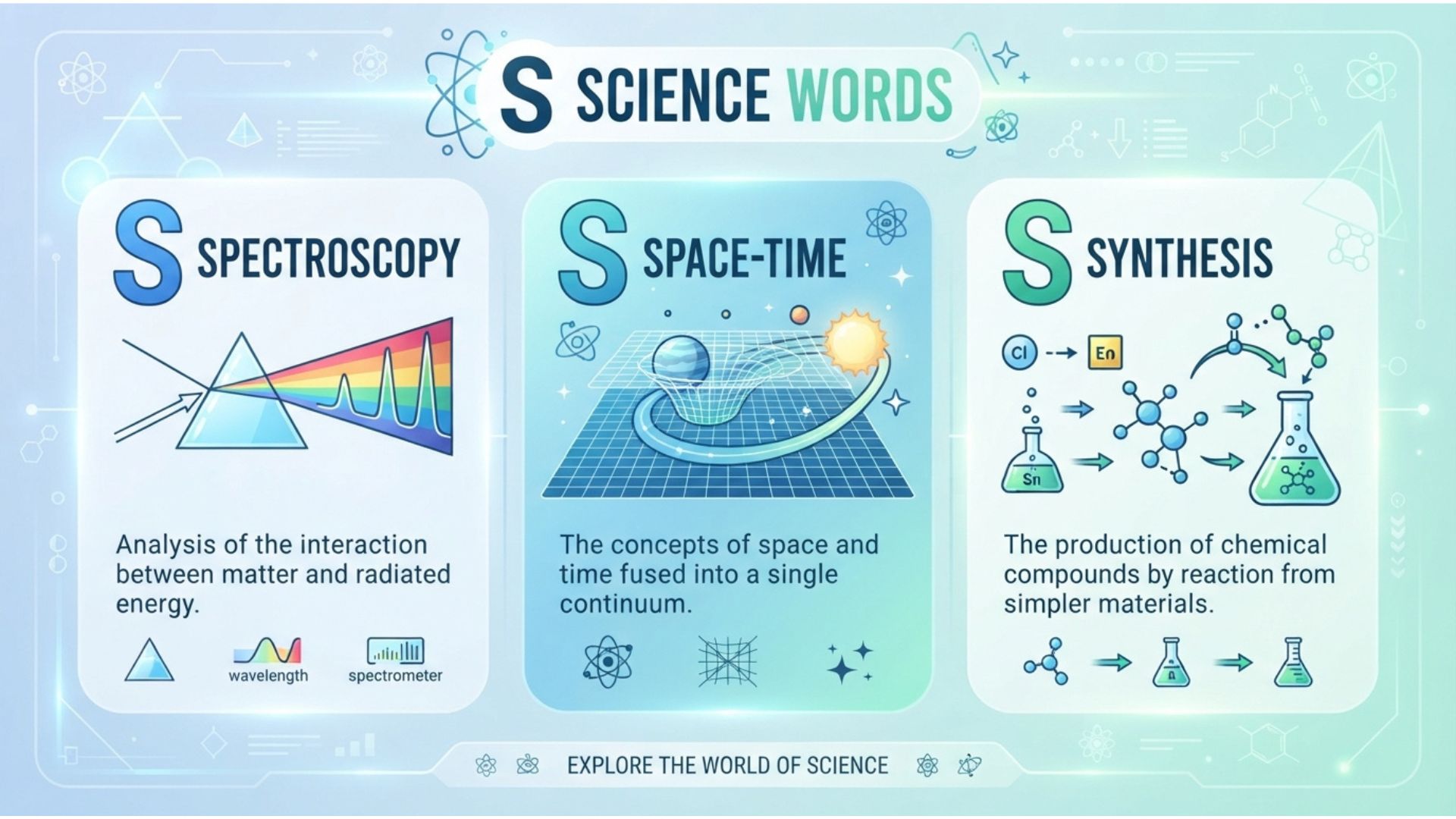
- Spectroscopy studying how matter absorbs and emits light to identify what it’s made of, used across forensics, medicine, and astronomy.
Biology Science Words That Start With S
Biology produces one of the largest clusters of science terms that start with s, since reproduction, cell function, and ecosystems all draw heavily from this letter.
| Word | Meaning |
| Species | Organisms that can breed together and produce fertile offspring |
| Stem cell | An unspecialized cell capable of becoming many different cell types |
| Symbiosis | Two species living in an ongoing close relationship |
| Spore | A single-celled reproductive structure in fungi, mosses, and ferns |
| Stimulus | Any environmental signal that causes an organism to respond |
| Synapse | The gap between two nerve cells, crossed by chemical messengers |
| Selective permeability | A cell membrane’s ability to control what enters and exits |
| Sexual reproduction | Reproduction combining genetic material from two parents |
| Succession | Gradual change in an ecosystem over time |
| Saprophyte | An organism that feeds on dead organic matter |
| Somatic cell | Any body cell that isn’t a reproductive cell |
| Sensory neuron | A nerve cell carrying signals from the senses to the brain |
Earth Science Words That Start With S
Earth science ties several s words in science directly to geology, erosion, and deep time.
- Sediment small particles of rock, sand, or organic material deposited by water or wind, the building block of river deltas.
- Strata layered rock stacked over time, with older layers sitting beneath newer ones, read almost like pages of a history book.
- Seismic waves energy waves traveling through Earth during an earthquake, useful for mapping what the planet’s interior actually looks like.
- Subduction one tectonic plate sliding beneath another, a process that builds volcanoes and carves deep ocean trenches.
- Soil horizon a distinct layer within soil, running from topsoil down through subsoil to bedrock.
- Stalactite a mineral formation hanging from a cave ceiling; the “c” in stalactite is a handy memory hook for ceiling.
- Stalagmite a mineral formation rising from a cave floor; the “g” is the matching hook for ground.
- Sinkhole a ground depression caused by the collapse of dissolved underground rock, often limestone.
- Stratovolcano a steep, layered volcano built from alternating lava and ash, with Mount Fuji as a well-known example.
Space & Astronomy Science Words That Start With S
Astronomy hands over some of the most recognizable science words with s, several tied to phenomena visible from Earth.
- Satellite any object orbiting a larger one; the Moon is Earth’s natural satellite, and GPS depends on artificial ones.
- Solar system the Sun plus everything gravitationally bound to it, including planets, moons, asteroids, and comets.
- Solar wind a constant stream of charged particles flowing outward from the Sun, responsible for auroras near Earth’s poles.
- Supernova the explosive death of a massive star, briefly bright enough to outshine an entire galaxy.
- Star a massive ball of gas undergoing nuclear fusion, with our Sun ranking as a fairly average, medium-sized example.
- Spiral galaxy a pinwheel-shaped galaxy with curved arms of stars, the shape of our own Milky Way.
- Singularity the point at a black hole’s center where density becomes theoretically infinite.
- Solar flare a sudden burst of radiation from the Sun’s surface, capable of disrupting power grids and radio signals on Earth.
- Solstice the point in Earth’s orbit when one pole tilts closest to the Sun, marking the start of summer or winter.
Medical & Health Science Words That Start With S
Clinical vocabulary leans heavily on s science words, many of which patients hear directly during an appointment.
| Word | Meaning |
| Symptom | A sign of illness the patient notices, like a fever |
| Syndrome | A cluster of symptoms that appear together, pointing to a specific condition |
| Synovial fluid | Fluid inside joints that reduces friction between bones |
| Systolic pressure | Blood pressure measured during a heartbeat, the top number in a reading |
| Sepsis | A life-threatening body response to infection |
| Serotonin | A brain chemical affecting mood, sleep, and appetite |
| Spinal cord | The nerve bundle running down the back, linking brain to body |
| Sterilization | Eliminating all microorganisms from a surface or instrument |
Technology & Applied Science Words That Start With S
Applied science rounds out the list with science terms that start with s that show up in everyday devices.
- Semiconductor a material that conducts electricity better than an insulator but worse than a true conductor; silicon is the most common example, and without semiconductors there’s no such thing as a smartphone.
- Software coded instructions that tell hardware exactly what to do.
- Sensor a device that detects a change in its environment and sends a signal, found in everything from thermostats to motion lights.
- Sonar a system that sends sound waves and reads their reflection to map underwater terrain or locate objects.
- Servo a motor with built-in position feedback, common in drones, robotic arms, and steering systems.
- Solar panel a device that converts sunlight into electrical energy through the photovoltaic effect.
- Synthetic material a human-made material not found in nature, including plastics, nylon, and kevlar.
Which S Science Words Appear Most Often on Exams?
Solution, symbiosis, stimulus, sediment, and solar system show up most consistently across science tests, largely because they’re foundational s science words that later, more advanced terms build directly on top of. Locking in this short list early pays off across nearly every grade level that follows.
Science Words That Start With S For Kids (Grades 3–6)
Younger learners need science words with s tied to things they can picture immediately.
| Word | What It Means |
| Sun | The star at the center of our solar system |
| Seed | A plant embryo enclosed in a protective coat |
| Soil | The top layer of Earth where plants grow |
| Shell | The hard outer covering of snails, crabs, and turtles |
| Shadow | The dark area where an object blocks light |
| Solid | A state of matter with a fixed shape and volume |
| Stem | The part of a plant that carries water upward |
| Smoke | Particles and gases released when something burns |
| Spring | A coil that stores mechanical energy, or a natural water source |
| Sink | What happens when an object is denser than the liquid it’s placed in |
Science Words That Start With S 7th Grade Focus
These science terms that start with s appear regularly across 7th-grade curricula.
- Symbiosis and its three types mutualism, commensalism, and parasitism.
- Stimulus and response a core concept in behavior and the nervous system.
- Sublimation a must-know phase change alongside melting and freezing.
- Seismic waves central to units on Earth’s interior and earthquakes.
- Solar system components planets, moons, asteroids, and comets.
- Suspension vs. solution a comparison that shows up on nearly every exam.
- Succession how ecosystems change gradually over time.
- Selective permeability the cell membrane’s core function.
- Spore vs. seed two different reproduction strategies compared side by side.
- Strata reading rock layers as a record of Earth’s past.
Complete Reference List 115+ Science Words That Start With S
Every s science words entry referenced across this guide, plus additional terms from advanced coursework, gathered in one place.
| # | Word | # | Word | # | Word |
| 1 | Salivary amylase | 40 | Solid | 79 | Substrate |
| 2 | Saponification | 41 | Solstice | 80 | Succession |
| 3 | Saprophyte | 42 | Solubility | 81 | Sucrose |
| 4 | Sapwood | 43 | Solute | 82 | Sulfide |
| 5 | Saltation | 44 | Solution | 83 | Superfluid |
| 6 | Satellite | 45 | Solvent | 84 | Supernova |
| 7 | Saturated solution | 46 | Somatic cell | 85 | Supersaturated |
| 8 | Scalar | 47 | Somatosensory cortex | 86 | Supersonic |
| 9 | Sclerenchyma | 48 | Sonar | 87 | Superposition |
| 10 | Sediment | 49 | Sound | 88 | Surface tension |
| 11 | Sedimentation | 50 | Space-time | 89 | Surfactant |
| 12 | Seismic | 51 | Speciation | 90 | Suspension |
| 13 | Selective breeding | 52 | Species | 91 | Symbiont |
| 14 | Selective permeability | 53 | Specific heat | 92 | Symbiosis |
| 15 | Semiconductor | 54 | Spectroscopy | 93 | Sympatric speciation |
| 16 | Sensory neuron | 55 | Spectrum | 94 | Symptom |
| 17 | Sepsis | 56 | Speed | 95 | Synapse |
| 18 | Serotonin | 57 | Spinal cord | 96 | Synchrotron |
| 19 | Servo | 58 | Spinal reflex | 97 | Syndrome |
| 20 | Sexual reproduction | 59 | Spiral galaxy | 98 | Synergy |
| 21 | Shadow | 60 | Spore | 99 | Synodic period |
| 22 | Shear force | 61 | Sporophyte | 100 | Synthesis |
| 23 | Shell | 62 | Spring | 101 | Synthetic material |
| 24 | Sieve tube | 63 | Spring tide | 102 | Synovial fluid |
| 25 | Signal processing | 64 | Stalactite | 103 | Systemic |
| 26 | Simple harmonic motion | 65 | Stalagmite | 104 | Systolic pressure |
| 27 | Singularity | 66 | Standard solution | 105 | Scalar field |
| 28 | Sinkhole | 67 | Star | 106 | Seed |
| 29 | Snell’s Law | 68 | Static electricity | 107 | Seismology |
| 30 | Software | 69 | Stem | 108 | Smoke |
| 31 | Soil | 70 | Stem cell | 109 | Solenoid |
| 32 | Soil erosion | 71 | Stereospecific | 110 | Stereoscopic |
| 33 | Soil horizon | 72 | Sterilization | 111 | Sublittoral |
| 34 | Solar | 73 | Stimulus | 112 | Symbiogenesis |
| 35 | Solar flare | 74 | Stochastic | 113 | Solar eclipse |
| 36 | Solar panel | 75 | Stoichiometry | 114 | Sound barrier |
| 37 | Solar system | 76 | Strain | 115 | Specific gravity |
| 38 | Solar wind | 77 | Strata | ||
| 39 | Sound wave | 78 | Stratovolcano |
Advanced Science Words That Start With S
These science terms that start with s belong in high school, college, or specialized coursework.
- Stoichiometry calculating exact quantities of reactants and products using mole ratios and balanced equations.
- Stochastic involving randomness or probability, applied in climate modeling, genetics, and financial science.
- Superposition in quantum mechanics, a particle existing in multiple states simultaneously until it’s observed.
- Sympatric speciation a new species forming from a single ancestor without any geographic separation, a rarer and more debated process than the geographically separated kind.
- Synchrotron a ring-shaped particle accelerator where particles gain speed with each loop, used in both medical imaging and materials research.
- Somatosensory cortex the brain region processing touch, pain, temperature, and body position.
- Stereospecific reaction a reaction that produces one specific three-dimensional molecular arrangement, a critical detail in pharmaceutical drug design.
- Superfluid a phase of matter that flows with zero resistance; liquid helium becomes superfluid near absolute zero.
How Many Science Words Start With the Letter S?
This guide documents more than 115 distinct science terms beginning with S, spread across physics, chemistry, biology, earth science, astronomy, medicine, and technology. That makes S one of the most tool-rich letters in scientific vocabulary a natural result of how many core scientific ideas, from states of matter to species and solutions, happen to start with this exact sound.
Real-Life Connections
Science vocabulary isn’t confined to a textbook. Here’s where s science words actually show up.
At a hospital: Doctors track symptoms and syndromes, surgeons rely on sterilized instruments, joint pain often traces back to depleted synovial fluid, and serotonin levels factor directly into mental health treatment.
In your kitchen: Dissolving sugar in tea creates a solution the sugar is the solute, the water is the solvent, and add too much sugar and it becomes saturated.
Outdoors: Your shadow forms wherever your body blocks light, rivers carry sediment downstream, and coastal temperatures stay mild thanks to water’s high specific heat.
Inside your own body right now: Sensory neurons are sending signals to your brain, serotonin is shaping your mood, and synovial fluid is letting your knees bend without friction.
In current news: Solar flares disrupting satellite communication, seismic monitoring ahead of earthquakes, and semiconductor shortages affecting car and phone manufacturing are all headlines built on this vocabulary.
Common Confusions Cleared Up
A handful of science terms that start with s pairs trip up students constantly because they sound alike or overlap in meaning.
Stalactite vs. Stalagmite Both form in caves from dripping mineral water. Stalactites hang from the ceiling “c” for ceiling. Stalagmites rise from the ground “g” for ground.
Solute vs. Solvent vs. Solution Salt water has all three. Salt is the solute, being dissolved. Water is the solvent, doing the dissolving. Salt water itself is the solution, the finished result.
Speed vs. Velocity Speed measures how fast. Velocity measures how fast and in which direction. “60 km/h” is speed; “60 km/h heading north” is velocity.
Symbiosis vs. Mutualism Symbiosis is the broad term covering any close biological relationship. Mutualism is one type, where both organisms benefit; parasitism is also symbiosis, just one-sided.
Spore vs. Seed Seeds come from flowering plants and pack food reserves for the embryo inside. Spores, produced by fungi, mosses, and ferns, are simpler, single-celled, and carry no food supply.
Suspension vs. Colloid vs. Solution A solution dissolves fully and stays clear, like saltwater. A suspension settles over time, like muddy water. A colloid stays spread without ever settling, like milk.
Syndrome vs. Symptom A symptom is a single sign, like a fever. A syndrome is a recognized pattern of several symptoms appearing together.
FAQs
Which s science words should I learn first for exams?
Focus on the basics: solution, symbiosis, stimulus, sediment, and solar system. These s science words appear constantly on tests and build the foundation for harder terms later.
How can I remember science terms that start with S without memorizing everything?
Connect them to real life. Notice examples around you a shadow, soil in a garden, a solution in your tea and these science terms that start with s start sticking naturally.
What’s the easiest way to understand difficult S words in science?
Break the word into parts and read a simple definition first, then connect it to an example you already know. Complex s words in science get much easier once you see them applied.
Are all science words with S important for younger students?
Not all at once. Start with basics like sun, seed, and solid, then move toward harder science words with s only once the easy ones feel comfortable.
What is the most useful s science word to know first?
Solution is a strong starting point, since it anchors chemistry vocabulary and connects directly to related terms like solute, solvent, and saturation.
Why do so many science words start with S?
Several foundational ideas across nearly every science field states of matter, species, solutions, sound, speed happen to begin with S, which is why s science words cover such wide ground.
Is a symptom the same thing as a syndrome?
No. A symptom is one observable sign, like a cough, while a syndrome is a cluster of symptoms that together point to a specific, recognized condition.
Conclusion
Every entry on this list of s science words connects to something real sunlight is reaching you through a process astronomers study, your last cup of tea was a working chemistry solution, and your body is running on serotonin and synovial fluid right now. That’s what separates useful vocabulary from random trivia you forget the next day.
You now have 115+ terms sorted by subject, by grade level, and by where they show up in real life, plus a clear answer to the confusions that trip up students most, from science terms that start with s in chemistry to the ones running the devices in your pocket. Whether you’re studying for a test or just chasing curiosity, this list is built to hold up under real use. The next S-word on your worksheet won’t slow you down.

Samuel Prescott explores Bible meanings, biblical names, and scripture insights, helping readers uncover deeper faith and understanding.