Tristan Name Meaning Bible: Powerful Sacred Meaning
Maybe you’re holding a tiny name on a list, turning it over in your mouth, wondering if it carries something deeper than sound. Tristan has that effect on people it feels old, a little wistful, and strangely strong all at once.
This guide walks through the tristan name meaning bible connection from every angle: its roots, its emotional weight, and how its story echoes through Scripture even without a direct verse. You’ll also see the tristan meaning in bible themes of sorrow turning into hope, plus real verses, real biblical figures, and honest answers. Keep reading it’s worth the few minutes.
Tristan Name Meaning Bible
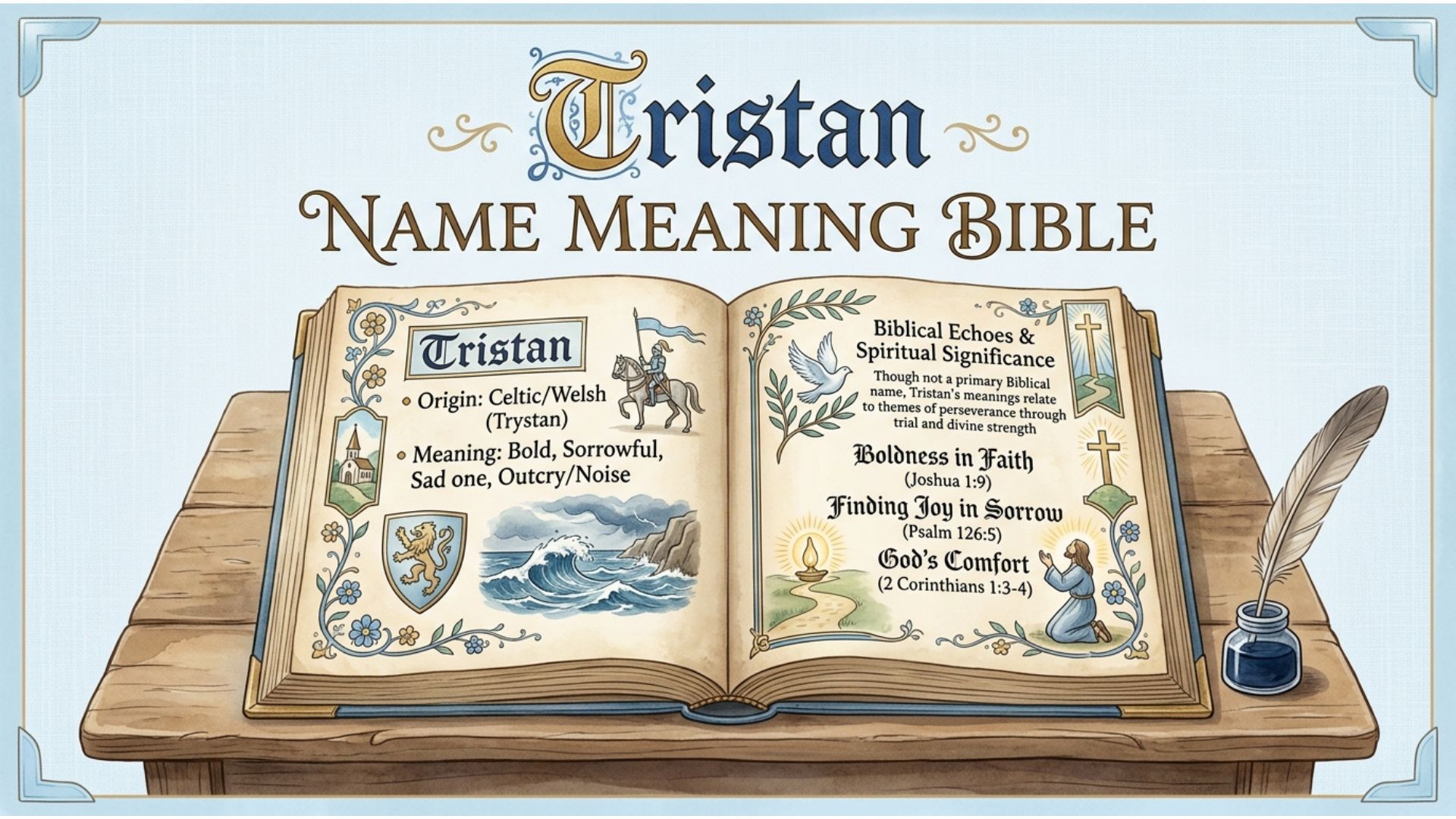
Parents searching for the tristan name meaning bible connection usually land here for one reason: they want a name that feels beautiful and meaningful. Tristan carries a rare combination a name born from sorrow in Latin, yet forged with courage in its Celtic roots.
- Sorrow from the Latin tristis, meaning sad or melancholic
- Courage from the Celtic Drustan, meaning bold or tumultuous
- Depth a name that holds both grief and grit in the same breath
- Legacy popularized through the medieval tale of Tristan and Isolde
- Resonance a name that mirrors the human experience Scripture never shies away from
Example in reflection: Person A: “Why did you choose the name Tristan for him?” Person B: “Because it means sorrow turned to strength that’s the story I want for his life.”
How Is Tristan’s Meaning Understood Today?
Modern parents rarely pick Tristan for its literal Latin definition. They’re drawn to the layered story behind it a name that admits life is hard while still pointing toward hope.
- Emotional honesty the name doesn’t pretend sorrow isn’t real
- Strength paired with a Celtic warrior undertone
- Uniqueness less common than Ethan or Noah, yet still familiar
- Timelessness rooted in centuries-old legend
- Faith compatibility easily paired with a Christian upbringing
Tristan Meaning in Bible
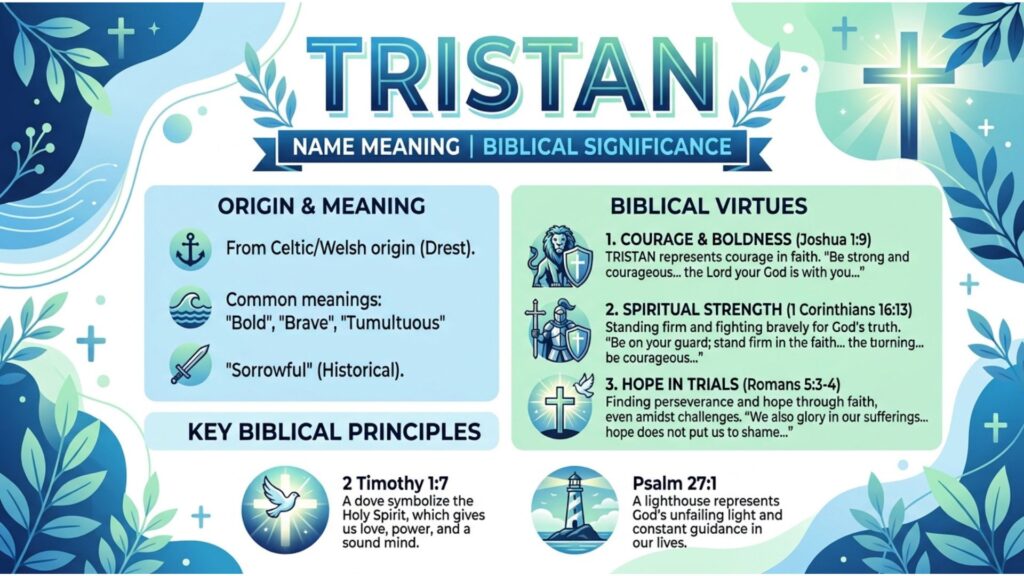
The tristan meaning in bible search doesn’t lead to a chapter and verse it leads somewhere more personal. Tristan isn’t a Hebrew or Greek name, so it never appears on a page of Scripture. What it does share with the Bible is a theme: sorrow that doesn’t get the final word.
- Not a Hebrew name no direct linguistic tie to Scripture’s original languages
- Thematic overlap sorrow, endurance, and redemption run through both
- Symbolic bridge connects a personal name to a universal biblical arc
- Spiritual reading many Christian parents read meaning into names beyond their literal origin
- Encouragement a name that can become a quiet, daily reminder of God’s faithfulness
| Aspect | Tristan | Biblical Theme |
| Literal root | Sorrow (Latin) | Lament, mourning (Psalms) |
| Secondary root | Boldness (Celtic) | Perseverance (Romans 5) |
| Symbolic arc | Grief to strength | Suffering to glory (2 Corinthians 4) |
| Modern use | Christian baby name | Personal testimony |
Tristan in the Bible
Searching for Tristan in the Bible itself will come up empty and that’s worth saying plainly instead of dancing around it. No king, no disciple, no minor character carries this name in the Old or New Testament.
- Old Testament no occurrence of Tristan in Hebrew Scripture
- New Testament no occurrence in the Greek text either
- Apocrypha not present in extrabiblical Jewish texts
- Historical timeline the name emerged centuries after the biblical canon closed
- Cultural origin rooted in early British and French history, not the ancient Near East
Example in reflection: Person A: “Is Tristan actually written anywhere in Scripture?” Person B: “No, but its meaning still lines up with what the Bible teaches about pain and hope.”
What Does the Name Tristan Mean in the Bible
So what does the name Tristan mean in the Bible if it isn’t printed on any page? It means something borrowed and applied a name whose definition mirrors biblical truth even though its letters don’t appear in it.
- Sorrowful the most literal translation from Latin
- Bold the Celtic layer that softens the sadness
- Tested a name that fits someone who has weathered something hard
- Restored because Scripture insists sorrow is never permanent
- Purposeful echoing Romans 8:28’s promise that all things work for good
What Bible Verse Matches the Name Tristan?
People often want a single verse to anchor a name to their faith. For Tristan, one verse rises above the rest.
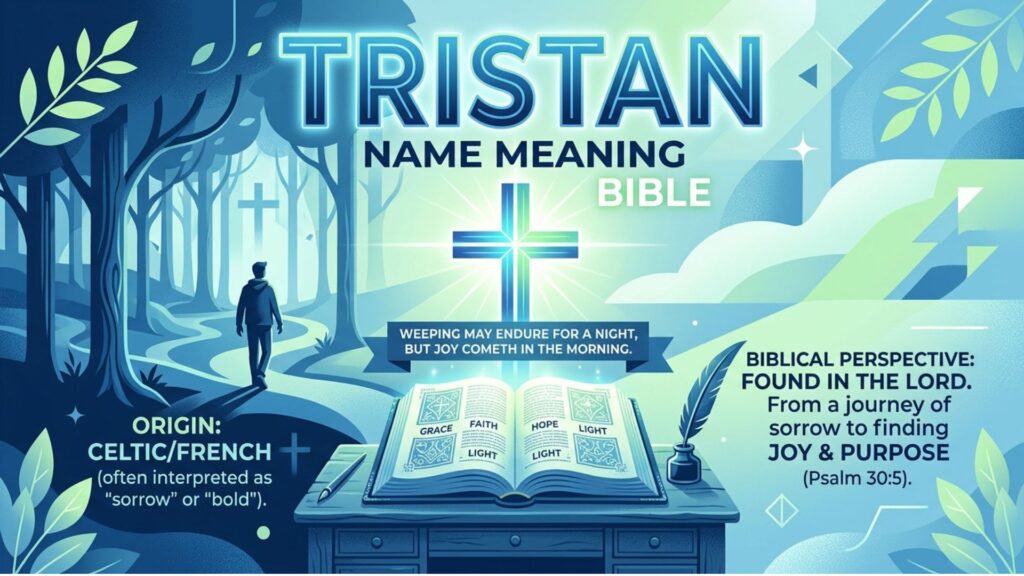
- Psalm 30:5 “Weeping may endure for a night, but joy comes in the morning”
- Isaiah 61:3 beauty given for ashes, joy for mourning
- Romans 5:3-4 suffering producing perseverance and hope
- John 16:20 grief that turns into joy
- Revelation 21:4 the promise that God will wipe away every tear
Is the Name Tristan in the Bible
This is the most literal version of the question, and the answer stays consistent: is the name Tristan in the Bible no, it is not, in any translation, including the King James Version, the NIV, or the original Hebrew and Greek manuscripts.
- Not in Hebrew manuscripts no matching root or transliteration
- Not in Greek manuscripts absent from the New Testament text
- Not a translated name unlike names such as John (from Yohanan) or James (from Jacob)
- Confirmed by concordances Strong’s and other biblical concordances list no entry
- Still meaningful absence from the text doesn’t erase spiritual relevance
Does Tristan Appear in the Bible?
The straightforward answer is no the name Tristan does not appear anywhere in the Bible, in either testament. No prophet, king, priest, or disciple carries this name. It comes from Celtic and Latin traditions, not the Hebrew or Greek languages that shaped Scripture.
- No prophets named Tristan absent from every prophetic book
- No kings named Tristan absent from every royal genealogy
- No disciples named Tristan absent from the Gospels and Acts
- Non-Hebrew origin rooted in Pictish and Latin language families
- Still spiritually rich many non-biblical names carry values that reflect God’s Word
However, the absence of a name in Scripture doesn’t strip it of spiritual weight. Countless names Christian families use today come from outside the Bible, yet they carry meanings that line up beautifully with faith. Tristan is exactly that kind of name.
Tristan Name Origin and Etymology
To fully grasp the biblical meaning of Tristan, it helps to trace where the name actually comes from and it’s a more layered story than most people expect.
| Origin | Root Word | Core Meaning |
| Latin | Tristis | Sad, sorrowful, melancholic |
| Celtic/Pictish | Drustan or Drust | Tumult, bold, warrior spirit |
| Old French | Tristan | Popularized through medieval literature |
| Welsh | Trystan | Noise, courage, inner strength |
Most scholars trace the name back to the ancient Pictish Drustan, common among Celtic warriors of early Britain. Over centuries it evolved through Old French into Tristan, gaining fame through the medieval legend of Tristan and Isolde a tragic love story built on longing, loyalty, and loss.
- Dual heritage sorrow from Latin, strength from Celtic tradition
- Medieval fame carried by one of literature’s most tragic heroes
- Cross-cultural spread adapted through French, Welsh, and English
- Modern usage now a popular Christian and secular baby name worldwide
Spiritual Meaning of Tristan in a Biblical Context
Even without a direct biblical mention, the spiritual meaning of Tristan aligns with some of Scripture’s most recurring themes sorrow, endurance, and divine purpose.
- Sorrow transformed by faith grief that God meets and redeems
- Endurance and perseverance the warrior spirit Scripture consistently honors
- Pain leading to divine purpose hardship reframed as preparation
- Honest emotion a name that doesn’t hide from human struggle
- Hope as the final word every biblical sorrow arc ends in restoration
The Latin root tristis means sorrowful, and sorrow is one of the most honest emotions explored throughout the Bible. From the Psalms of lament to Job’s afflictions and Christ’s grief in Gethsemane, Scripture never avoids human pain instead, it shows how God meets people in their lowest moments and turns mourning into meaning.
“Weeping may endure for a night, but joy comes in the morning.” Psalm 30:5
The Celtic root of Tristan meaning bold and tumultuous reflects the warrior spirit Scripture consistently celebrates. Paul’s writings brim with encouragement to endure hardship as a path to character and hope.
“Suffering produces perseverance; perseverance, character; and character, hope.” Romans 5:3-4
What Are the Deeper Spiritual Layers Behind Tristan’s Name?
Beyond sorrow and boldness, Tristan’s story carries a third layer worth noting: purpose.
- Refinement trials that shape character rather than break it
- Companionship with God a reminder that no sorrow is walked alone
- Testimony pain that eventually becomes someone else’s encouragement
- Legacy of faith a name that can be passed down with spiritual intention
One of the clearest biblical truths is that God uses pain purposefully. Joseph was sold into slavery before becoming a leader who saved nations. David wrote his most powerful psalms from places of deep grief. Job lost everything, yet his faith produced a testimony that still speaks today.
“And we know that in all things God works for the good of those who love him.” Romans 8:28
Tristan Meaning in Hebrew and Greek Traditions
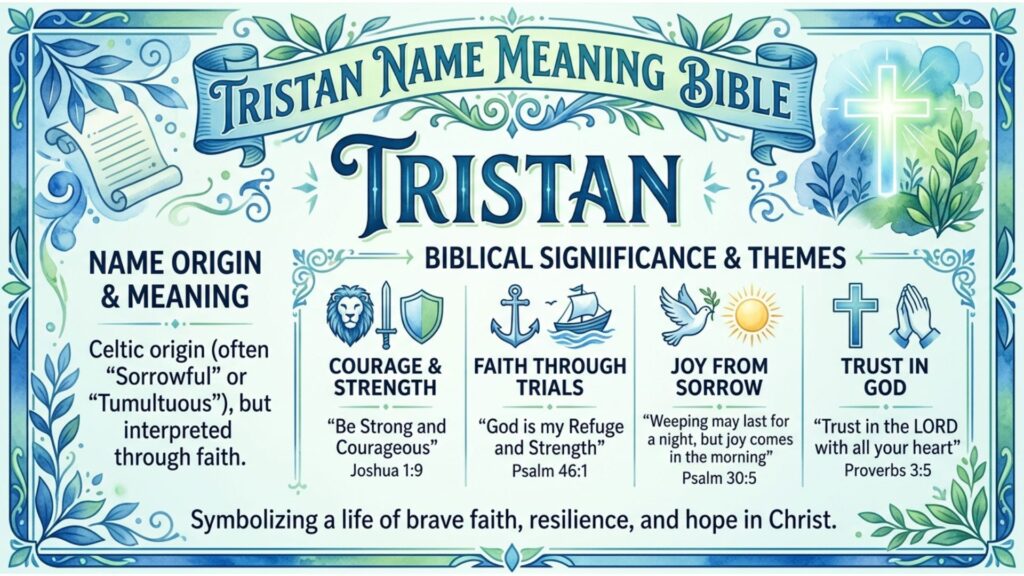
Since Tristan isn’t a biblical-language name, curious readers often ask how it would even look inside Hebrew or Greek the two languages Scripture was originally written in.
- Hebrew transliteration written phonetically as טריסטן, with no independent Hebrew meaning
- Greek transliteration rendered as Τρίσταν, also purely phonetic
- No root meaning neither language assigns Tristan an original definition
- Comparison names unlike Daniel (Hebrew for “God is my judge”), Tristan has no Hebrew root
- Common practice many modern names are transliterated into biblical languages without carrying inherited meaning
Example in reflection: Person A: “Does Tristan mean anything special in Hebrew?” Person B: “Not really it’s just spelled out phonetically, no built-in Hebrew meaning.”
Key Bible Verses That Reflect the Tristan Name
The following scriptures echo the core themes embedded in the Tristan biblical symbolism sorrow met by grace, and endurance met by hope.
| Verse | Theme | Connection to Tristan |
| Psalm 34:18 | Comfort in brokenness | God near the brokenhearted |
| Isaiah 41:10 | Strength in fear | Overcoming sorrow with courage |
| James 1:12 | Reward for perseverance | Endurance under trial |
| 2 Corinthians 4:17 | Eternal glory from present pain | Sorrow producing something greater |
| Psalm 46:1 | Refuge in trouble | God as ever-present help |
- Psalm 34:18 “The Lord is close to the brokenhearted and saves those who are crushed in spirit”
- Isaiah 41:10 God promises strength to those who feel afraid and overwhelmed
- James 1:12 those who persevere under trial receive the crown of life
- 2 Corinthians 4:17 present troubles are producing an eternal glory far beyond comparison
- Psalm 46:1 God is an ever-present help in times of trouble
Each of these passages speaks directly to the emotional and spiritual dimensions of the name Tristan a soul acquainted with struggle yet anchored in divine hope.
What Does the Name Tristan Symbolize Spiritually?
This is one of the most-searched questions tied to the name, and it deserves a direct answer rooted in both etymology and faith.
- Symbol of resilience sorrow that doesn’t stay sorrow forever
- Symbol of courage the Celtic warrior undertone running beneath the name
- Symbol of honesty an unwillingness to fake happiness through pain
- Symbol of hope every biblical sorrow theme resolves in restoration
- Symbol of identity a name that can shape how someone sees their own story
Example in reflection: Person A: “What does Tristan symbolize to you personally?” Person B: “Someone who’s been through something hard and came out stronger in faith.”
Tristan and Biblical Figures Who Shared His Journey
Though no biblical character bears the name Tristan, several Scripture figures walked a path that mirrors its meaning sorrow met with unshakeable faith.
- Job endured profound sorrow and loss, yet maintained faith and was ultimately restored by God
- David wrote psalms of deep anguish while remaining a man after God’s own heart
- Joseph experienced betrayal and hardship that God used to fulfill an incredible purpose
- Jeremiah known as the “weeping prophet,” he carried the burden of a broken nation yet remained obedient to God’s call
- Hannah prayed through years of grief before receiving God’s answer
- Naomi walked through devastating loss before witnessing restoration through Ruth
Each of these figures embodied the essence of Tristan’s name: sorrow met with unshakeable faith.
Is Tristan Mentioned in Any Bible Verse?
A quick, honest answer to a common search: no single Bible verse mentions Tristan by name, because the word itself never appears in any biblical manuscript, translation, or concordance.
- No direct mention confirmed across every major translation
- No Strong’s Concordance entry the name has no Hebrew or Greek reference number
- No apocryphal mention absent from deuterocanonical texts as well
- Verses can still apply passages about sorrow and hope remain relevant by theme
- Common misconception many assume a name must appear in Scripture to hold spiritual value
Is Tristan a Good Christian Name?
Absolutely. Choosing the name Tristan for a child doesn’t require it to appear in Scripture. What matters far more is the character and faith the person lives out. The name carries a built-in spiritual reminder that life will hold sorrowful seasons, but God’s grace is sufficient, and His purposes are always redemptive.
- Doesn’t need biblical origin many beloved Christian names come from outside Scripture
- Built-in reminder sorrow met by faith, spoken every time the name is used
- Widely accepted used comfortably across many Christian denominations
- Pairs well with middle names often combined with biblical middle names for extra depth
- Growing in popularity increasingly chosen by Christian families in the West
Many Christian parents today are drawn to Tristan precisely because it captures a truthful, grounded faith one that doesn’t pretend life is painless but trusts that God is present in every trial.
Tristan Name Meaning and Personality Traits
Names often shape how people are perceived, and Tristan’s dual root gives it a distinctive personality profile that many parents find appealing.
- Reflective drawn to depth and quiet introspection
- Resilient able to endure hardship without losing hope
- Courageous carries a natural boldness from its Celtic root
- Compassionate sorrow-rooted names often correlate with empathy
- Loyal echoing the devotion found in the Tristan and Isolde legend
| Trait | Root Connection | Biblical Parallel |
| Resilience | Latin sorrow root | Romans 5:3-4 |
| Courage | Celtic warrior root | Joshua 1:9 |
| Compassion | Emotional depth of the name | Psalm 34:18 |
| Loyalty | Medieval legend of devotion | Ruth 1:16 |
Popularity and Modern Use of the Name Tristan in Christian Families
Tristan has steadily climbed in popularity among Christian and secular families alike, valued for sounding both classic and current.
- Ranking consistently placed in the top 200 boy names in the U.S. in recent years
- Christian appeal often chosen alongside biblical middle names like James or Michael
- Global reach popular in English-speaking, French, and Scandinavian countries
- Media influence kept culturally relevant through literature, film, and television
- Faith framing increasingly described by parents as a “meaningful, not literal” biblical name
| Region | Popularity Trend |
| United States | Steady top-200 ranking |
| United Kingdom | Moderate, consistent use |
| France | Historic popularity via legend |
| Christian households | Rising as a “meaningful” name choice |
Frequently Asked Questions
Is Tristan a biblical name?
No, Tristan does not appear in the Bible; the tristan name meaning bible connection is thematic, not literal, since it comes from Celtic and Latin origin.
What does Tristan mean spiritually?
It symbolizes sorrow transformed into strength, echoing the broader tristan meaning in bible theme of endurance and redemption through faith.
What is the Latin meaning of Tristan?
The Latin root tristis means “sad” or “sorrowful,” reflecting the emotional depth behind the tristan name meaning bible discussion.
Does Tristan have a Hebrew meaning?
No, Tristan has no Hebrew origin; within the tristan name meaning bible context, it can only be phonetically transliterated into Hebrew.
What Bible verse best connects to the name Tristan?
Psalm 30:5 “Weeping may endure for a night, but joy comes in the morning” best captures the tristan name meaning bible message.
Is Tristan a good name for a Christian boy?
Yes, within the tristan name meaning bible conversation, it reflects genuine faith that acknowledges hardship while trusting God’s purpose.
What is the Celtic meaning of Tristan?
The Celtic root means “tumult” or “bold,” adding courage and strength to the overall tristan name meaning bible picture.
Conclusion
The tristan name meaning bible search may not lead to a specific verse or character, but it speaks loudly to the heart of what Scripture teaches. Rooted in the Latin word for sorrow and the Celtic spirit of courage. The tristan meaning in bible theme reminds every parent and believer that grief is never the final chapter.
If you or someone you love carries this name, let it be a daily reminder that God turns grief into grace and trials into testimony. A name doesn’t need to be printed in Scripture to point straight back to it sometimes the quietest names carry the loudest reminders of faith.

Samuel Prescott explores Bible meanings, biblical names, and scripture insights, helping readers uncover deeper faith and understanding.