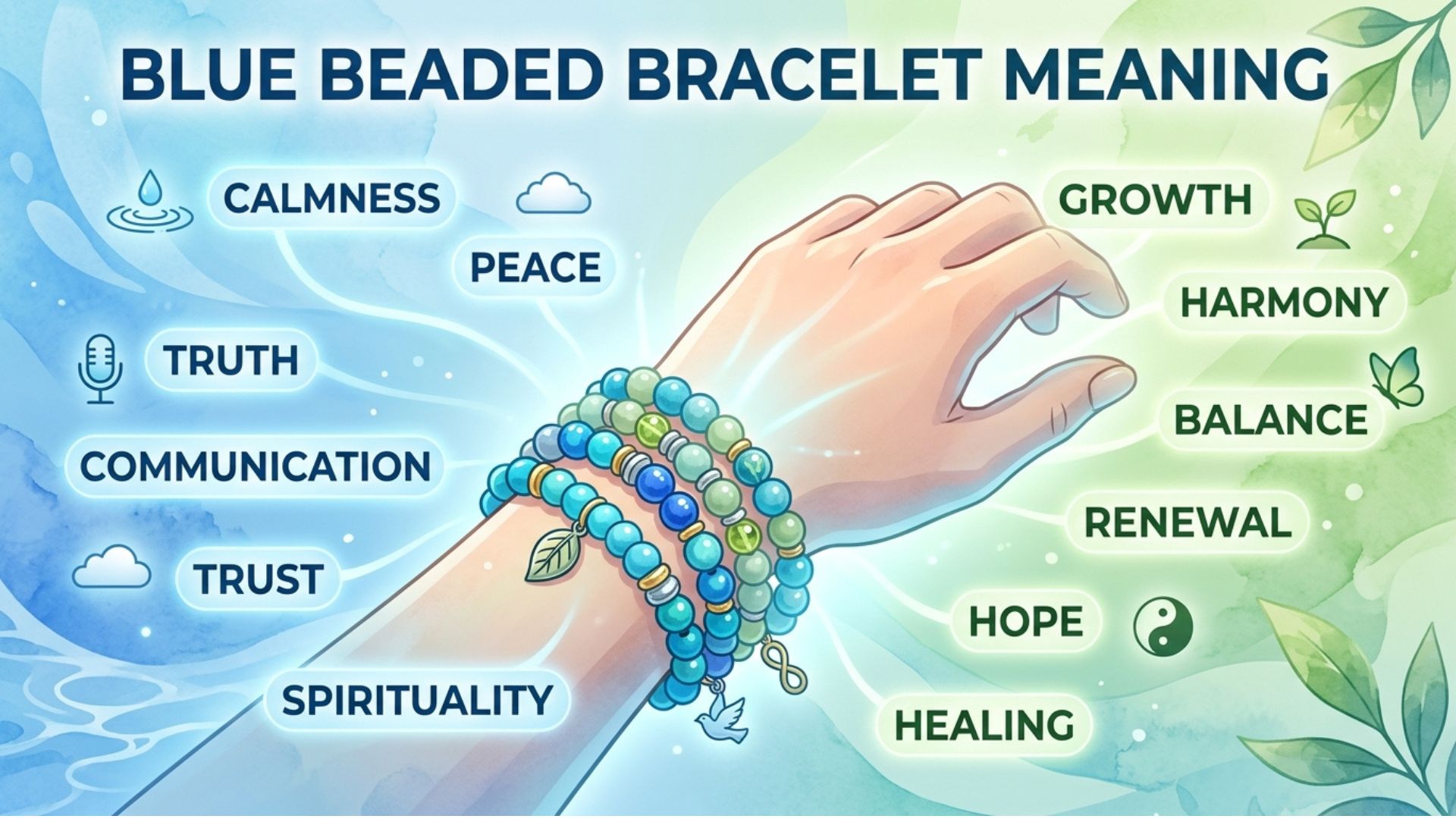
Blue Beaded Bracelet Meaning: The Powerful Truth Behind It
There’s something oddly comforting about slipping on a bracelet before you leave the house like it’s quietly saying I’m not alone in this. Maybe you got yours from a friend, found it while scrolling social media, or picked it up because the color blue just felt calming that day. Whatever the reason, you’re probably here because you want to know what it actually means, not just what it looks like.
That’s exactly what this guide is for. We’re breaking down the full blue beaded bracelet meaning from ancient history to modern activism so you can wear yours with real understanding instead of guesswork. We’ll also cover the blue bracelet meaning behind today’s viral trends, the communities who claim this color, and how to pick one that actually reflects your story. Keep reading, because the answer might surprise you.
Blue beaded bracelet meaning
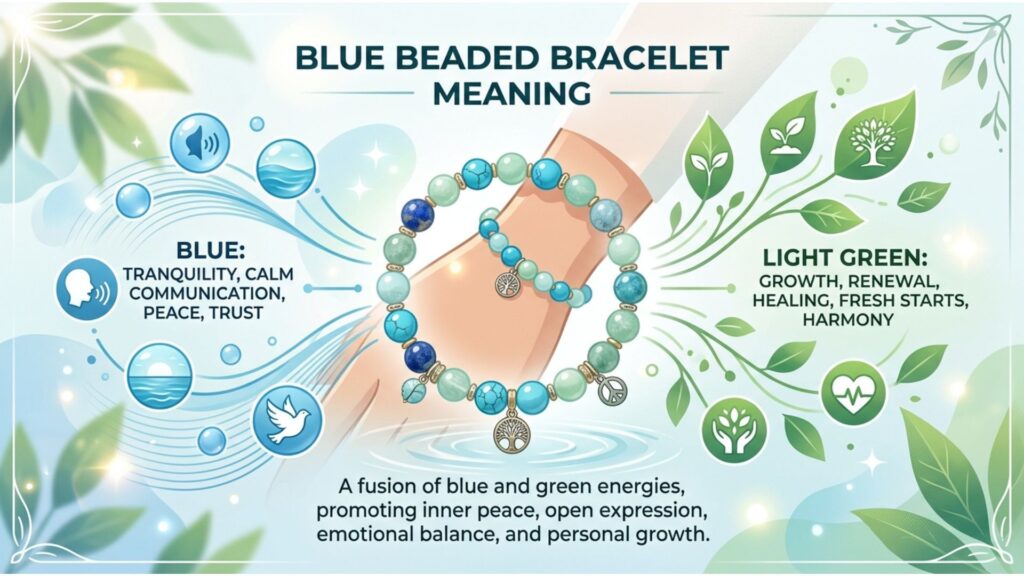
The blue beaded bracelet meaning blends centuries-old tradition with modern-day symbolism, making it one of the most emotionally layered accessories you can wear. Unlike a plain bangle, beaded designs carry extra weight because each bead can represent a gemstone, an intention, or a personal milestone. People choose blue beads specifically because the color is linked to calm, trust, and communication across nearly every culture.
Historically, artisans strung blue glass or stone beads together not just for decoration but as protective charms. Today, that same instinct shows up when someone gifts a friend a beaded bracelet to say “I’ve got you.” The blue beaded bracelet meaning isn’t fixed it shifts depending on the wearer, the occasion, and the community behind the color but the emotional thread of care and connection stays constant.
What Makes a Beaded Bracelet Different From a Plain Blue Bracelet?
- Material matters: beads are often gemstone, glass, or wood, unlike solid bangles.
- Symbol-layering: each bead can carry its own meaning within the set.
- Customization: beaded styles are easy to personalize with initials or charms.
- Texture and feel: beads offer a tactile, almost meditative quality when worn.
- Gifting tradition: beaded bracelets are commonly handmade and exchanged as tokens.
Example in conversation: Friend 1: “Why do you always wear that blue beaded one?” Friend 2: “My sister made it it’s kind of our thing now.”
Blue bracelet meaning
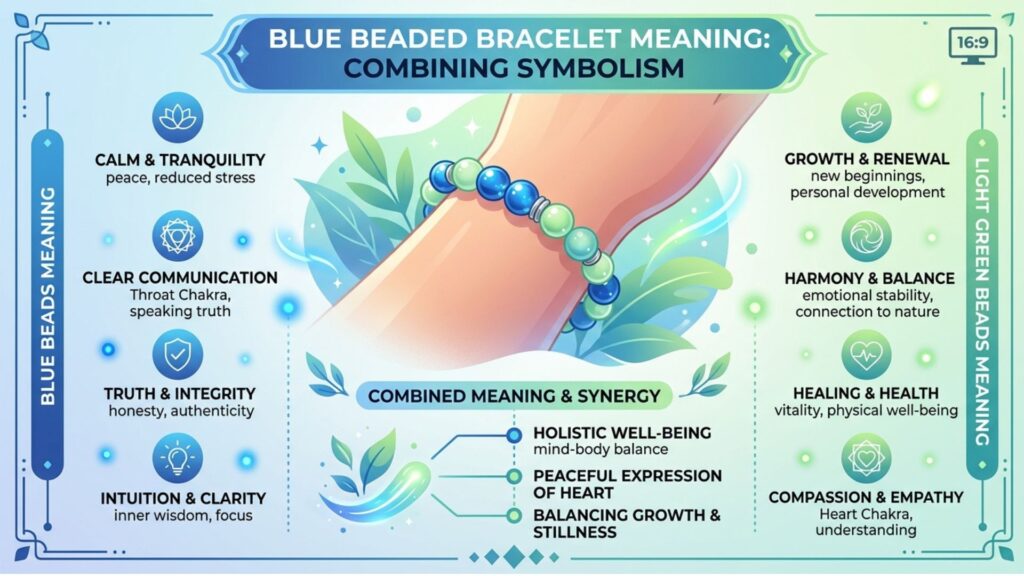
At its core, the blue bracelet meaning centers on trust, loyalty, and awareness. Blue has long been associated with calm waters and open skies, which is why so many cultures independently landed on it as a color of protection and peace. When someone wears a blue bracelet today, they’re often signaling one of three things: personal connection, cause-based support, or simple aesthetic preference rooted in that sense of calm.
The blue bracelet meaning has expanded fast in the last few years thanks to social media. What used to be a quiet, personal symbol is now a very public one, often tied to a specific campaign or moment in the news cycle.
| Blue Bracelet Context | Primary Meaning | Common Wearers |
| Friendship bracelet | Loyalty, bond, care | Kids, teens, close friends |
| Awareness bracelet | Human trafficking, dyslexia support | Advocates, survivors, allies |
| Political/social symbol | Allyship, solidarity | Activists, community members |
| Spiritual/healing bead | Calm, protection, intuition | Wellness-focused wearers |
Example in chat: Friend 1: “Everyone on my feed has a blue bracelet suddenly.” Friend 2: “Yeah, it’s become a whole solidarity thing this year.”
What Does Each Blue Bead Color Symbolize?
Not every “blue” bead means the same thing, and that surprises a lot of people who assumed the color itself was the whole story. Shade, material, and cultural entity all shift the message a single bead sends.
- Cobalt blue beads historically signaled status and protection in Byzantine glasswork.
- Sky blue beads are tied to calm, clarity, and open communication.
- Navy beads often represent stability, discipline, or quiet confidence.
- Turquoise-blue beads carry healing and protective associations in many traditions.
- Sapphire-toned beads are linked to wisdom, loyalty, and truth.
- Glass blue beads reference the ancient cobalt-blue trade routes archaeologists still study.
Blue bracelets
Blue bracelets as a category cover far more ground than most people realize friendship bands, medical alert bracelets, protest symbols, and spiritual jewelry all fall under this one umbrella. What ties them together is intention. You may have noticed the blue bracelet trend gaining momentum everywhere, from schools to social media, and that visibility is exactly why the meaning keeps evolving.
In fact, 87.4% of children have worn one, and 79.5% of caregivers report seeing them often, according to published research data. That kind of reach means blue bracelets aren’t a niche accessory anymore they’re a genuinely widespread form of quiet communication.
Where Are Blue Bracelets Most Commonly Worn?
- Schools: kids trade them as friendship tokens.
- Protests and rallies: worn as visible solidarity markers.
- Hospitals: some awareness campaigns use them for patient support.
- Workplaces: subtle signals of shared values among coworkers.
- Online communities: shared via unboxing videos and trend posts.
Blue Beaded Bracelet Color Meanings and Bead Types
People searching for bracelet meanings almost always want to know which specific bead or shade fits their intention, so this breakdown pulls together the most-searched blue bead types and what each one is generally believed to represent.
| Bead Type | Common Association | Popular Use |
| Lapis lazuli | Truth, wisdom, insight | Spiritual jewelry |
| Blue lace agate | Calm communication | Anxiety relief pieces |
| Aquamarine | Courage, clarity | Gifts for travelers |
| Blue tiger’s eye | Confidence, focus | Everyday wear |
| Sodalite | Logic, self-trust | Study or work accessories |
What does a blue bracelet mean
When someone asks what does a blue bracelet mean, they’re usually trying to decode a specific context did a friend give it to them, did they see it on a stranger, or did it show up in a viral video? The honest answer is that meaning depends entirely on setting. A blue bracelet at a middle school lunch table means something different than one worn to a rally downtown.
Broadly, though, the color blue consistently maps to hope, unity, and calm across the examples people search for most. Recent order data shows blue bracelets now commonly stand for human trafficking awareness and dyslexia awareness, which explains why so many people encounter one and immediately want context.
- Awareness pieces often name the cause on an attached tag.
- Friendship versions usually have no formal cause attached at all.
- Movement-linked bracelets tend to appear in clusters around specific dates.
- Gift bracelets frequently include a personal note explaining the choice.
Why Do People Wear Blue Beaded Bracelets Today?
People wear them for reasons that go well beyond fashion comfort, memory, identity, and belonging all show up in the answers real wearers give when asked directly.
- Comfort: many describe the beads as grounding during stressful days.
- Memory: bracelets often honor a person, trip, or milestone.
- Identity: color choice can reflect personal or cultural values.
- Belonging: matching sets signal friendship or team unity.
- Awareness: some wearers intentionally support a visible cause.
Example in texting: Friend 1: “New bracelet?” Friend 2: “Yeah, blue’s my calm color, needed it this week.”
Key Takeaways
- The blue beaded bracelet meaning blends ancient tradition with modern activism and personal expression.
- Blue bracelets represent everything from friendship to human trafficking awareness and dyslexia support.
- The blue bracelet meaning shifted sharply after 2024, tied to political solidarity and allyship online.
- Critics warn against performative allyship wearing a symbol without backing it up with action.
- Real impact comes from listening to communities and acting, not just wearing a bracelet.
Blue Bracelets: Symbolism and Meaning
Traditional Associations
You can trace blue bracelets back to ancient cultures, where they served as protective charms and status markers rather than casual accessories. Archaeologists have uncovered striking physical evidence of just how far this tradition reaches.
- Cobalt-blue bracelets from the 11th and 12th centuries used varied cobalt colorants, some with high zinc content similar to Islamic plant-ash glass.
- Researchers analyzed 78 glass bracelet fragments from Isaccea, Romania, dating from the 10th to 13th centuries, and confirmed cobalt gave the glass its blue tone.
- At Nufaru, a Byzantine site, 20 glass bracelet fragments revealed cobalt, manganese, copper, and iron working together to produce the signature hue.
- Old Rus cities also had blue glass bangles, some imported from Byzantium, showing how far this trade and this symbolism traveled.
Blue bracelets have always carried meaning. In the past, they often represented friendship, protection, or a link to a group, and those threads still shape today’s designs.
Modern Interpretations
Blue bracelets now carry layered, modern significance. You might see them as solidarity symbols or as a quiet nod to a cause you personally care about. Blue friendship bracelets remain especially popular among younger wearers who want a visible way to celebrate their bonds without saying a word.
The color blue continues to represent hope and unity, and when you wear one, you join a much larger, mostly informal network of people signaling similar values whether that’s ending exploitation, supporting dyslexia awareness, or simply reminding a friend they matter.
The Blue Bracelet Movement
Political and Social Context
The blue bracelet movement gained massive traction right after the 2024 U.S. elections, when many women particularly white women began wearing them as a political statement. The gesture was meant to signal support for marginalized communities and opposition to specific political positions.
- The movement went viral on TikTok and Instagram in November 2024.
- A single video reached over 5.1 million views, showing how fast the trend spread.
- Black-owned jewelry sellers, including Beaded & Balanced Jewelry, sold over 200 blue bracelets in that window.
- The bracelets functioned as an informal social identifier, helping wearers find allies in public spaces.
Commentators noted the movement mirrors past protest symbols, like the pink pussy hats of 2016 or the Safety Pin Movement, and just like those earlier symbols, it quickly drew both support and skepticism.
Allyship and Inclusivity
Wearing a blue bracelet is often meant as a signal of allyship and inclusivity a way to show up for people facing discrimination without needing a formal introduction. Research backs up how well this actually works as a signal.
- In controlled experiments, colored bracelets helped participants identify in-group members with a 65% accuracy rate.
- These small markers measurably shift how people perceive and respond to strangers.
- Bracelets show up frequently at protests, rallies, and community events as visible support markers.
Wearing a blue bracelet can be a first step. Real impact comes from listening, learning, and acting far beyond the accessory itself.
Is a Blue Bracelet the Same as a Blue Beaded Bracelet?
Not exactly and the distinction matters more than people expect once they start comparing styles side by side.
- Solid bangles are usually mass-produced and symbol-focused.
- Beaded versions are often handmade, layered, and more personal.
- Beaded bracelets allow for gemstone-specific meanings a plain band can’t offer.
- Movement-linked bracelets tend to favor simple bands for visibility.
- Gift and healing bracelets almost always lean toward beaded designs.
How to Choose a Blue Beaded Bracelet That Matches Your Story
Picking the right one comes down to intention are you honoring a cause, a friendship, or your own need for calm? That single question narrows the options fast.
- Match the bead to the cause or feeling you want to represent.
- Check the material gemstone, glass, or wood each carry different weight.
- Consider size and stack-ability if you wear multiple bracelets.
- Ask about origin if supporting an artisan or awareness campaign matters to you.
- Choose comfort over trend if you’ll wear it daily.
Criticisms and Controversies
Performative Allyship
Not everyone views the trend positively. Many critics argue blue bracelets can slide into performative allyship showing support for a cause without backing it up with meaningful action. Someone might wear one to appear caring or involved while never actually engaging with the communities they claim to support.
Putting on a bracelet is simple. Acting on its meaning is often much harder.
Some call this “moral posturing,” arguing that a symbol alone rarely creates real change unless it’s paired with genuine listening and effort.
- Some wear blue bracelets to fit in with a group rather than to help anyone.
- Attention can shift toward the symbol itself instead of the underlying issue.
- Certain communities feel these gestures skip over deeper, harder problems.
Community Perspectives
Opinions vary widely across communities. The University of Wisconsin Police Department faced strong backlash over its use of the “thin blue line” symbol, which connects loosely to broader blue bracelet symbolism some community members associated it with extremism and felt unsafe, prompting the department to limit its use and rebuild trust.
This example is a useful reminder: a simple gesture rarely resolves deep problems on its own, and listening to the people most affected is essential to understanding a symbol’s real impact.
Blue Beaded Bracelet Meaning in Spiritual and Healing Practices
Beyond activism, plenty of people reach for blue beads purely for the calming, grounding effect they’re said to provide during stressful stretches of life.
- Lapis lazuli beads are tied to insight and inner truth.
- Sodalite beads are linked to focus and rational thinking.
- Blue lace agate is associated with soothing anxious thoughts.
- Aquamarine beads are worn for courage before big transitions.
- Turquoise pairs protection with emotional balance in many traditions.
Beyond Blue Bracelets: Meaningful Support
Taking Real Action
Real impact starts where the bracelet leaves off. Wearing one signals concern, but actions communicate far more. Research on wearable items backs this up directly measurable outcomes appear when people pair a symbol with genuine behavior change.
| Wearable Type | Outcome Measured | Statistical Significance |
| Head-wear | Calm score improved | p=0.010 |
| Torso-wear | Long-term stress reduced | p=0.005 |
| Wrist-wear | Stress reduction, self-awareness | Positive results noted |
| Torso & finger-wear | Lowered breath rate | p<0.0001 |
| Finger-wear | Decreased negative mood, HR, temperature | p<0.001 |
A separate study on digital tracking and coaching found people who monitored their habits and got outside support saw genuine improvements in health proof that intention plus action outperforms a symbol alone.
Listening to Communities
Listening is a key part of meaningful support. Communities that prioritize active listening consistently report better, longer-lasting outcomes than those relying on symbols alone.
- Nonprofits that included people with lived experience shaped policies that helped more families.
- Girls Coordinating Councils worked directly with leaders, leading to fewer arrests and better outcomes.
- Advocacy councils gave formerly incarcerated people a real voice in shaping new laws.
- Schools gathered feedback from students and families before making major decisions.
- Community volunteers brought concerns straight to leaders, strengthening advocacy efforts.
Blue bracelets carry many meanings tradition, friendship, activism, or calm. What matters most is understanding why you’re wearing yours and backing that meaning with action, not just intention.
FAQs
What does a blue bracelet mean?
A blue bracelet can represent friendship, awareness, or activism depending on context. The blue bracelet meaning ultimately depends on your community and the moment.
What is the blue beaded bracelet meaning in gift-giving?
Gifted beaded bracelets usually symbolize care, protection, or a personal bond. The blue beaded bracelet meaning often reflects the relationship between giver and receiver.
Can you wear a blue bracelet for any cause?
Yes, a blue bracelet can represent various causes like human trafficking awareness or dyslexia support. Always confirm the blue bracelet meaning your community assigns before wearing one.
Are blue beaded bracelets religious or spiritual?
Some are, especially those using gemstones like lapis lazuli or turquoise. The blue beaded bracelet meaning in these cases usually centers on protection and calm.
How do you show real support beyond wearing a blue bracelet?
Listen to others, join community events, or volunteer directly. Acting delivers a far bigger impact than the blue bracelet meaning alone can carry.
Are blue bracelets always seen as positive?
Not always some view them as genuine support, while others see performative gestures. Understanding the full blue bracelet meaning requires respecting differing community opinions.
What bead color pairs well with blue for extra meaning?
White often pairs with blue for peace, while gold adds prosperity. Many combine these with the core blue beaded bracelet meaning for a fuller message.
Conclusion
The blue beaded bracelet meaning stretches from ancient Byzantine glasswork to today’s viral solidarity movements, and that range is exactly what makes it worth understanding before you wear one.
The broader blue bracelet meaning only matters, though, if it’s backed by genuine action listening, showing up, and supporting the communities these symbols reference. A bracelet can start a conversation, but it shouldn’t end one. Next time you clasp yours on, take a second to remember what it stands for, and let that meaning guide something you actually do today.

Samuel Prescott explores Bible meanings, biblical names, and scripture insights, helping readers uncover deeper faith and understanding.