Science Words That Start With P: The Ultimate List
Science class throws a lot of vocabulary at you fast, and the letter P alone seems to cover half the subject physics, biology, chemistry, medicine, even outer space. If you’ve ever paused mid-sentence trying to remember what “phototropism” actually means, you’re not alone.
This guide breaks down science words that start with p by subject, so you’re not scrolling through a random alphabetical list hoping to stumble on the term you need. You’ll find short, plain-language definitions, real examples, and a full reference table at the end covering 140+ terms. Whether you’re studying for a test or just curious about p science words, everything here is built to make sense the first time you read it.
Science words that start with p
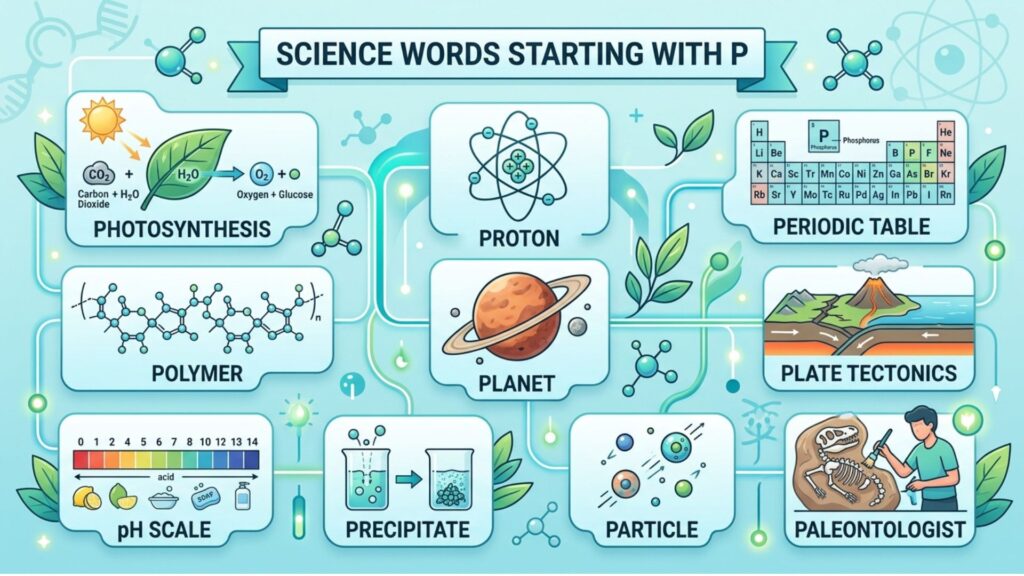
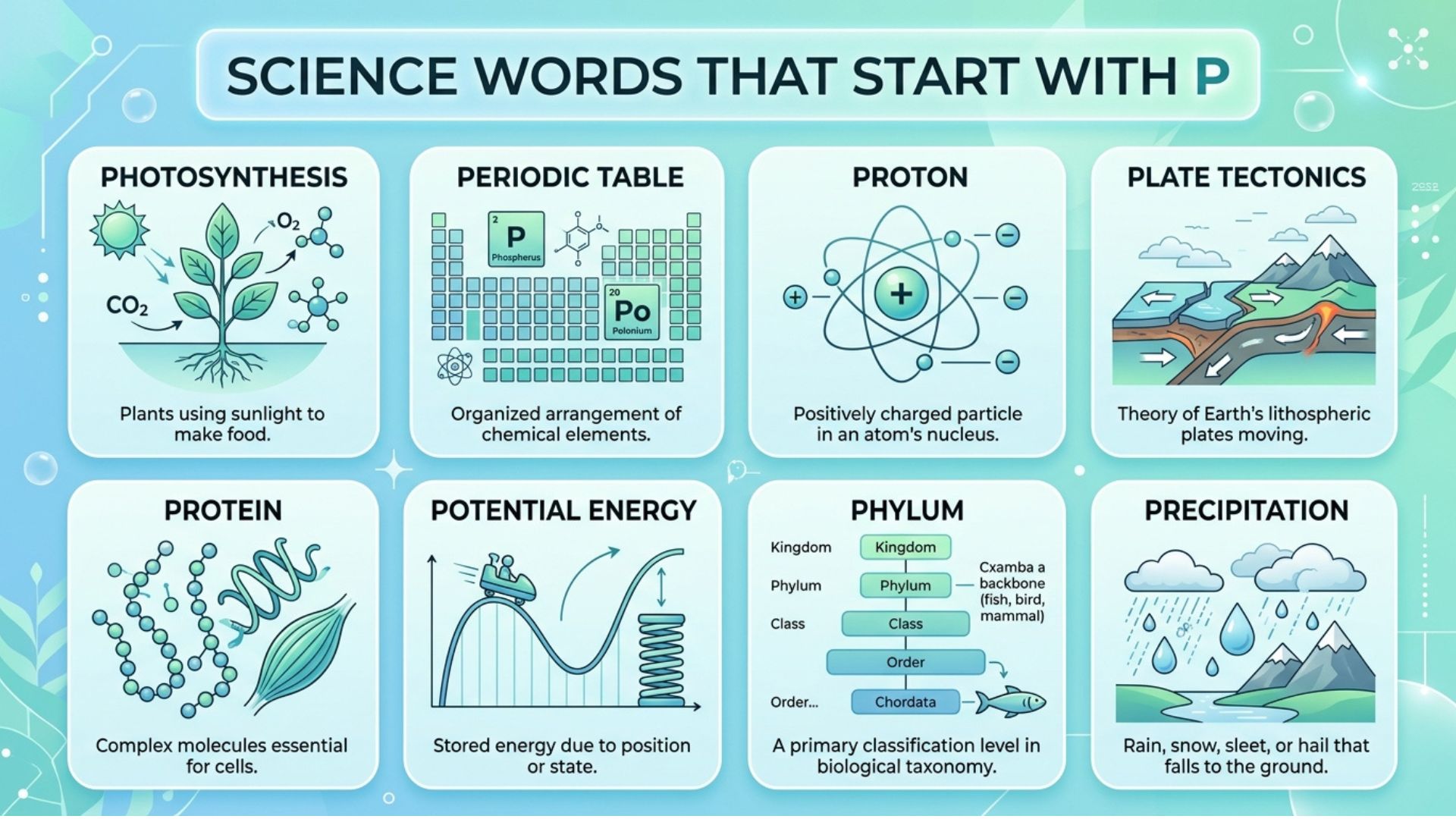
The letter P produces more core scientific vocabulary than almost any other letter in the alphabet partly because so many foundational Greek and Latin roots (photo-, poly-, para-, pro-) begin with it. That’s why science words that start with p show up constantly across biology, chemistry, physics, earth science, and medicine.
What makes this list useful isn’t just the definitions it’s understanding which field each word belongs to. “Precipitation” means something completely different in a chemistry lab than it does in a weather forecast, even though both trace back to the same root meaning “to fall.” Sorting these terms by subject, rather than dumping them into one giant glossary, makes them far easier to actually retain.
p science words
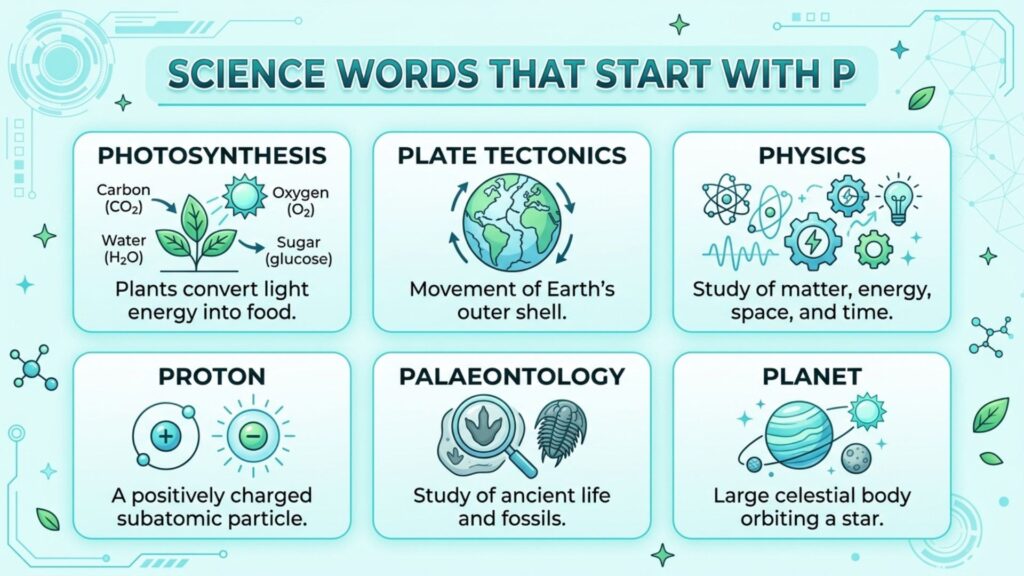
Searching specifically for p science words usually means you want a fast, no-fluff list rather than long explanations. Here’s a condensed starter set covering some of the most recognizable terms before we go deeper into each field:
- Photosynthesis how plants convert light into food
- Pressure force spread across a surface
- Proton a positively charged particle in an atom
- pH a scale measuring acidity
- Predator an animal that hunts others for food
These five alone appear in nearly every general science curriculum, which is why they’re worth memorizing before moving into more specialized categories.
biology words that start with p
Biology contributes a huge share of science words that start with p, mostly because so many life processes from digestion to reproduction have Latin-rooted names starting with this letter. A few standouts worth knowing early: photosynthesis, protein, pollination, predator, and parasite.
These words describe processes you can actually observe a plant leaning toward sunlight, a bee visiting a flower, a hawk diving toward prey. Because biology is so visual, these particular P-words tend to stick in memory faster than abstract physics or chemistry terms.
science terms that start with p
Beyond biology, science terms that start with p stretch across every discipline. Physics gives us pressure and photon. Chemistry gives us polymer and pH. Earth science gives us permafrost and plate tectonics. Astronomy gives us pulsar and parallax.
The pattern worth noticing is that a huge number of these terms share the same handful of Greek roots. Once you recognize that photo relates to light and poly relates to “many,” a dozen unfamiliar words suddenly become far easier to decode on sight, even the first time you encounter them.
p words in science
Not every list of p words in science needs to be exhaustive to be useful. Sometimes you just need enough to recognize a pattern. Here’s a quick spread across disciplines to show how wide this letter’s reach really is:
| Field | Example P Word |
| Physics | Pendulum |
| Chemistry | Precipitate |
| Biology | Phloem |
| Earth Science | Petroleum |
| Astronomy | Photosphere |
| Medicine | Pathogen |
| Technology | Pixel |
20 Most-Used Science Words That Start With P
These are the terms most likely to show up in textbooks, standardized tests, and everyday science conversation. If you only have time to learn one section, make it this one.
| Word | Meaning |
| Photosynthesis | Plants making food from sunlight, water, and CO₂ |
| Proton | Positively charged particle in an atom’s nucleus |
| Pressure | Force applied over a given surface area |
| Protein | Molecule built from amino acids, essential to the body |
| Plasma | The fourth state of matter; also part of blood |
| Pendulum | A swinging weight used to study time and motion |
| Pollination | Transfer of pollen that allows plants to reproduce |
| Predator | An animal that hunts other animals for food |
| Precipitation | Water falling from the sky as rain, snow, or hail |
| Periodic Table | Chart organizing every known chemical element |
| Pigment | A substance that gives color to a material |
| Parasite | An organism that lives off a host, causing it harm |
| Phloem | Plant tissue that carries sugar downward from leaves |
| Prism | A glass shape that splits light into a spectrum |
| Polymer | A large molecule made of repeating smaller units |
| Photon | The smallest unit of light energy |
| pH | A 0–14 scale measuring acidity or alkalinity |
| Pathogen | A microorganism that causes disease |
| Permafrost | Ground that stays frozen for two or more years |
| Pulsar | A fast-spinning neutron star that emits energy beams |
Physics Science Words That Start With P
Physics terms tend to describe forces, energy, and motion concepts you can’t always see directly but can measure and predict. Several of these science words that start with p explain everyday phenomena you’ve experienced without necessarily naming.
- Pressure Force divided by the area it’s spread across; a sharp point concentrates force more than a flat surface does.
- Pendulum A weight that swings back and forth at a steady rhythm, historically used to build accurate clocks.
- Photon A massless particle of light that carries pure energy.
- Polarization Restricting light waves to vibrate in a single direction, the principle behind polarized sunglasses.
- Power The rate at which energy is used or transferred, not a measure of raw strength.
- Potential Energy Stored energy based on an object’s position, like a ball held above the ground.
- Projectile Any object launched into the air that follows a curved path due to gravity.
- Pitch How high or low a sound is, based on the speed of its vibrations.
- Prism A transparent object that separates white light into its full color spectrum.
- Propagation The way waves sound, light, or water travel through a medium.
- Planck’s Constant A fixed number linking a photon’s energy to its frequency, central to quantum physics.
Chemistry Science Words That Start With P
Chemistry vocabulary usually centers on reactions, particles, and measurable properties of matter. These p science words show up constantly in lab reports and textbook problem sets.
- Periodic Table The chart that organizes all known elements by atomic number and shared properties.
- pH A scale from 0 to 14 showing how acidic or alkaline a substance is, with 7 as neutral.
- Polymer A long molecule built from repeating smaller units, found in plastic, rubber, and even DNA.
- Precipitate A solid that forms and separates out when two liquids react together.
- Proton A positively charged particle inside every atom’s nucleus, determining which element it is.
- Polarity An uneven distribution of electrical charge across a molecule, which is why water dissolves so many substances.
- Photolysis Using light energy to break a chemical compound apart, a step inside photosynthesis.
- Polymerization The chemical process of linking small monomers into a long polymer chain.
- Pyrolysis Breaking down material using heat without oxygen present, used in some recycling processes.
- Phosphorylation Attaching a phosphate group to a molecule, a key step in producing cellular energy.
Biology Science Words That Start With P
Biology is arguably the richest source of science words that start with p, since it names living structures, processes, and organisms in nearly every branch of the subject.
- Photosynthesis The reaction where sunlight, water, and carbon dioxide combine to create glucose and oxygen.
- Protein A molecule made from chains of amino acids that builds muscle, skin, and enzymes.
- Pollination The movement of pollen that allows flowering plants to produce seeds.
- Predator An organism that hunts and eats other animals to survive.
- Prey An animal that gets hunted and eaten by a predator.
- Parasite An organism that lives on or inside a host, drawing nutrients while harming it.
- Phloem Plant tissue that transports sugars downward from the leaves to the roots.
- Phototropism The tendency of plants to grow toward a light source.
- Prokaryote A single-celled organism, like bacteria, without a true nucleus.
- Phenotype An organism’s observable physical traits, shaped by both genes and environment.
- Placenta The organ that connects a developing fetus to its mother during pregnancy.
- Photoreceptor Specialized cells in the eye that detect light and color.
- Pheromone A chemical signal one organism releases to influence others of the same species.
- Phytoplankton Microscopic, plant-like organisms that produce much of the ocean’s oxygen.
- Pupa The stage between larva and adult in an insect’s life cycle.
- Population All the members of one species living in the same area at the same time.
Earth Science Words That Start With P
Earth science terms describe the planet’s structure, weather systems, and long-term geological processes. Many of these p science words connect directly to climate and natural resources.
| Word | Meaning |
| Precipitation | Water falling from the atmosphere as rain, snow, sleet, or hail |
| Permafrost | Ground that has stayed frozen for two or more years |
| Plate Tectonics | The theory that Earth’s crust is broken into moving plates |
| Paleontology | The study of ancient life through fossils |
| Petroleum | A liquid fossil fuel refined into gasoline and other products |
| Peat | Partially decomposed plant material that builds up in wetlands |
| Pyroclast | Rock and lava fragments thrown out during a volcanic eruption |
| Porosity | How much empty space exists inside rock or soil |
| Plateau | A raised, flat area of land higher than the surrounding terrain |
Space & Astronomy Science Words That Start With P
Space vocabulary describes objects and distances so large that everyday units stop making sense. These science words that start with p give astronomers a shared language for describing the universe.
- Planet A body that orbits a star, is rounded by its own gravity, and has cleared its orbital path.
- Pulsar A spinning neutron star that emits beams of energy, appearing to “pulse” from Earth.
- Parsec A unit of astronomical distance equal to about 3.26 light-years.
- Photosphere The visible surface of the Sun, where most of its light originates.
- Parallax The apparent shift in a star’s position, used to calculate its distance from Earth.
- Perihelion The point in a planet’s orbit where it’s closest to the Sun.
- Protostar A star still forming, pulling in gas and dust before fusion begins.
- Planetary Nebula A glowing cloud of gas released when a mid-sized star reaches the end of its life.
- Prominence A large loop of plasma that arcs out from the Sun’s surface.
Medical & Health Science Words That Start With P
Medical terminology shows up constantly outside the classroom too in doctor’s appointments, health articles, and news coverage. These p science words are worth knowing beyond just exam prep.
- Pathogen Any organism, like a bacterium or virus, that causes disease.
- Plasma (Blood) The liquid part of blood that carries cells, hormones, and nutrients.
- Platelet A tiny blood cell fragment that helps form clots after an injury.
- Pancreas An organ that produces digestive enzymes and regulates blood sugar with insulin.
- Pulmonary Anything related to the lungs and breathing.
- Pathology The medical study of disease causes, mechanisms, and effects.
- Placebo An inactive treatment used to compare results in clinical trials.
- Prognosis A doctor’s prediction of how a condition is likely to develop.
- Pneumonia A lung infection that causes inflammation and fluid buildup.
- Peripheral Describes structures at the outer edge of a system, like the peripheral nervous system.
Technology & Applied Science Words That Start With P
Applied science and technology terms describe the tools and systems built from scientific principles. These science words that start with p appear constantly in engineering and computing contexts.
- Pixel The smallest single unit that makes up a digital image.
- Photovoltaic A material or device that converts sunlight directly into electricity.
- Processor The central computing chip that carries out a device’s instructions.
- Piezoelectric A property of certain crystals that generates electricity when physically pressed.
- Protocol A set of rules two systems follow to exchange data, like HTTP for web pages.
- Pneumatics Engineering systems that use compressed air to create movement or force.
- Photolithography A technique that uses light to print microscopic circuits onto computer chips.
- Packet A small unit of data transmitted across a network.
Easy Science Words That Start With P (Grades 3–6)
Younger learners don’t need the technical depth of a lab manual just clear, simple definitions tied to things they can picture. These beginner-friendly science words that start with p are a good starting point.
| Word | Simple Meaning |
| Plant | A living thing that makes its own food from sunlight |
| Pond | A small body of freshwater with plants and animals |
| Push | A force that moves something away from you |
| Pull | A force that moves something toward you |
| Petal | A colorful flower part that attracts pollinators |
| Pore | A tiny opening that lets air or liquid pass through |
| Pulse | The rhythmic beat you feel where an artery is close to skin |
| Pod | The seed case of plants like peas and beans |
| Pebble | A small, smooth stone shaped by moving water |
| Pinecone | The seed-holding structure of a pine tree |
| Plankton | Tiny organisms that drift through ocean and lake water |
| Producer | A living thing, usually a plant, that makes its own food |
Advanced Science Words That Start With P
For high school, college, or independent study, these terms go a level beyond the basics. Expect to see these p science words in more specialized coursework.
- Polymerase An enzyme that builds new strands of DNA or RNA from an existing template.
- Phylogenetics The study of evolutionary relationships between species using genetic data.
- Psychrometer An instrument that measures humidity using two thermometers.
- Peristalsis The wave-like muscle contractions that move food through the digestive tract.
- Photoemission The release of electrons from a material’s surface when struck by light.
- Photochemistry The branch of chemistry that studies reactions triggered by light.
- Pinocytosis A process where a cell absorbs tiny droplets of surrounding fluid.
- Parenchyma The primary functional tissue in an organ or plant structure.
What’s the Difference Between Similar P Science Words?
A handful of P-terms sound alike or share roots but mean very different things depending on the subject. Mixing them up is one of the most common vocabulary mistakes students make on exams.
- Phloem vs. Xylem Phloem carries sugar downward from leaves; xylem carries water upward from roots.
- Prokaryote vs. Eukaryote Prokaryotes have no true nucleus; eukaryotes do.
- Predator vs. Parasite A predator kills quickly; a parasite drains its host slowly over time.
- Precipitate vs. Precipitation One is a chemistry term for a solid forming in solution; the other describes rain, snow, or hail.
- Phenotype vs. Genotype Phenotype is the visible trait; genotype is the underlying genetic code.
Complete Reference List 140+ Science Words That Start With P
Use this full alphabetical table as a study tool or quick lookup whenever you need a fast definition without scrolling back through every category above.
| Word | Meaning |
| Paleontology | Study of ancient life through fossils |
| Pancreas | Gland producing insulin and digestive enzymes |
| Parallax | Apparent shift in a star’s position used to measure distance |
| Parasite | Organism harming its host while feeding off it |
| Parasitism | A relationship where one organism benefits at another’s expense |
| Parenchyma | Functional tissue in an organ or plant |
| Parsec | Distance unit equal to about 3.26 light-years |
| Pathogen | Disease-causing microorganism |
| Pathogenesis | The process by which a disease develops |
| Pathology | Medical study of disease causes and effects |
| Peat | Partially decomposed wetland plant matter |
| Pebble | Small stone smoothed by water |
| Pendulum | Swinging weight used to study motion and time |
| Peneplain | Flat landscape formed by long-term erosion |
| Perihelion | Point in orbit closest to the Sun |
| Peripheral | Relating to the outer edge of a system |
| Peristalsis | Muscle waves that move food through digestion |
| Permafrost | Ground frozen continuously for two or more years |
| Petal | Colorful flower part that attracts pollinators |
| Petroleum | Liquid fossil fuel refined into fuel and plastics |
| pH | Scale measuring acidity or alkalinity, 0 to 14 |
| Phase | A distinct stage in a repeating cycle or process |
| Phenotype | Observable physical traits of an organism |
| Pheromone | Chemical signal influencing behavior in the same species |
| Phloem | Plant tissue transporting sugars downward |
| Phosphate | A chemical group involved in energy transfer |
| Phosphorylation | Adding a phosphate group to a molecule |
| Photochemistry | Chemistry of light-driven reactions |
| Photoemission | Electron release from a material struck by light |
| Photolithography | Light-based printing of circuits on computer chips |
| Photolysis | Breaking apart compounds using light energy |
| Photon | Smallest packet of light energy |
| Photoperiod | The amount of daylight an organism receives |
| Photoreceptor | Eye cells detecting light or color |
| Photosphere | Visible outer surface of the Sun |
| Photosynthesis | Plant food production using sunlight, water, and CO₂ |
| Phototropism | Plant growth directed toward a light source |
| Photovoltaic | Converting sunlight directly into electricity |
| Phylogenetics | Mapping evolutionary relationships among species |
| Phylum | A major taxonomic category grouping related organisms |
| Phytoplankton | Microscopic aquatic plant-like organisms |
| Piezoelectric | Generating electrical charge from mechanical pressure |
| Pigment | Substance that produces color in living or non-living matter |
| Pinecone | Seed-bearing structure of pine trees |
| Pinocytosis | Cell absorbing fluid droplets from its surroundings |
| Pitch | Highness or lowness of a sound |
| Pixel | Smallest unit of a digital image |
| Placebo | Inactive treatment used in clinical trials |
| Placenta | Organ nourishing a fetus during pregnancy |
| Planck’s Constant | Value linking photon energy to frequency |
| Planet | Body orbiting a star that has cleared its orbital path |
| Planetary Nebula | Gas shell released by a dying mid-sized star |
| Plankton | Tiny organisms drifting in water |
| Plant | Photosynthetic organism that makes its own food |
| Plasma (Blood) | Liquid part of blood carrying cells and nutrients |
| Plasma (Matter) | Ionized gas; the fourth state of matter |
| Plateau | Raised, flat landform |
| Plate Tectonics | Theory of moving crustal plates shaping Earth |
| Platelet | Blood cell fragment involved in clotting |
| Pneumatics | Systems using compressed air for movement |
| Pneumonia | Lung infection causing fluid buildup |
| Pod | Seed casing of legume plants |
| Polarity | Uneven charge distribution within a molecule |
| Polarization | Restricting light waves to a single plane |
| Pollen | Fine powder carrying a plant’s male sex cells |
| Pollination | Pollen transfer enabling plant fertilization |
| Pollutant | A substance that contaminates air, water, or soil |
| Pollution | Contamination of the environment by harmful substances |
| Polymer | Large molecule made of repeating units |
| Polymerase | Enzyme that builds DNA or RNA strands |
| Polymerization | Chemical bonding of small units into a polymer |
| Pond | Small freshwater ecosystem |
| Population | All members of a species in one area |
| Pore | Tiny opening allowing gas or fluid exchange |
| Porosity | Proportion of empty space within rock or soil |
| Positron | The antimatter counterpart of an electron |
| Potential Energy | Stored energy based on position |
| Power | Rate at which energy is transferred or used |
| Precipitate | Solid formed when two solutions react |
| Precipitation | Water falling from the atmosphere as rain, snow, or hail |
| Predation | One organism hunting and consuming another |
| Predator | Animal that hunts other animals for food |
| Pressure | Force applied over a given surface area |
| Prey | Animal hunted and eaten by a predator |
| Primary Consumer | Organism that feeds directly on producers |
| Prism | Object that splits light into a spectrum |
| Probability | The measured likelihood of an event occurring |
| Processor | Central computing chip executing instructions |
| Producer | Organism that generates its own food |
| Product | A substance formed as the result of a chemical reaction |
| Prognosis | Medical prediction of how a condition will progress |
| Projectile | Object launched through air under gravity |
| Prokaryote | Single-celled organism lacking a true nucleus |
| Prominence | Plasma loop erupting from the Sun’s surface |
| Propagation | Movement of a wave through a medium |
| Propulsion | The force that drives an object forward |
| Protein | Amino acid chain with structural or functional roles |
| Protocol | Standardized rules for data communication |
| Protostar | Forming star before nuclear fusion begins |
| Prototype | An early working model used for testing |
| Psychrometer | Instrument measuring air humidity |
| Puberty | Hormone-driven transition into biological adulthood |
| Pull | Force drawing an object toward its source |
| Pulmonary | Relating to the lungs |
| Pulsar | Rapidly spinning neutron star emitting energy beams |
| Pulse | Rhythmic beat caused by heart contractions |
| Pupa | Insect life stage between larva and adult |
| Pure Substance | Matter made of only one type of particle |
| Purity | The degree to which a substance is free of contaminants |
| Push | Force moving an object away from its source |
| Pyroclast | Volcanic rock and lava fragments from an eruption |
| Pyrolysis | Breaking down material with heat and no oxygen |
FAQs about Science Words That Start With P
Which science words that start with P are most important for exams?
Focus on high-frequency terms like photosynthesis, pressure, pH, predator, and precipitation, since these anchor major topics in every science subject.
How can I memorize so many p science words at once?
Break each word into its root. Once you know photo means light, several unfamiliar terms become instantly easier to decode.
What’s the difference between similar science words that start with p, like predator and parasite?
A predator kills prey quickly for food, while a parasite lives on a host over time, draining it gradually.
Are these science words that start with p useful outside of school?
Yes terms like pressure, pathogen, protein, and plasma show up regularly in health news, weather reports, and everyday conversation.
Do all science words that start with p come from Greek or Latin?
Most do. Roots like photo-, poly-, pro-, and para- explain why so many P-terms cluster around similar meanings.
Is pH really a science word that starts with P?
Yes pH is short for “potential of hydrogen,” and it’s one of the most commonly tested p science words in chemistry.
What’s the best way to teach science words that start with p to younger students?
Start with concrete, visible examples like plant, pond, and pulse before introducing abstract terms like polymer or phenotype.
Conclusion
Science words that start with p cover an enormous range from the pressure in a bicycle tire to the pulsar spinning light-years away. Once you sort them by subject instead of trying to memorize a flat alphabetical list, the sheer number stops feeling overwhelming.
The 140+ terms above give you a solid foundation whether you’re prepping for an exam, helping with homework, or just satisfying your own curiosity about how these p science words fit together. The fastest way to keep building this vocabulary is to notice the roots repeating across categories once photo, poly, and para start feeling familiar, new science words that start with p stop being strangers

Samuel Prescott explores Bible meanings, biblical names, and scripture insights, helping readers uncover deeper faith and understanding.