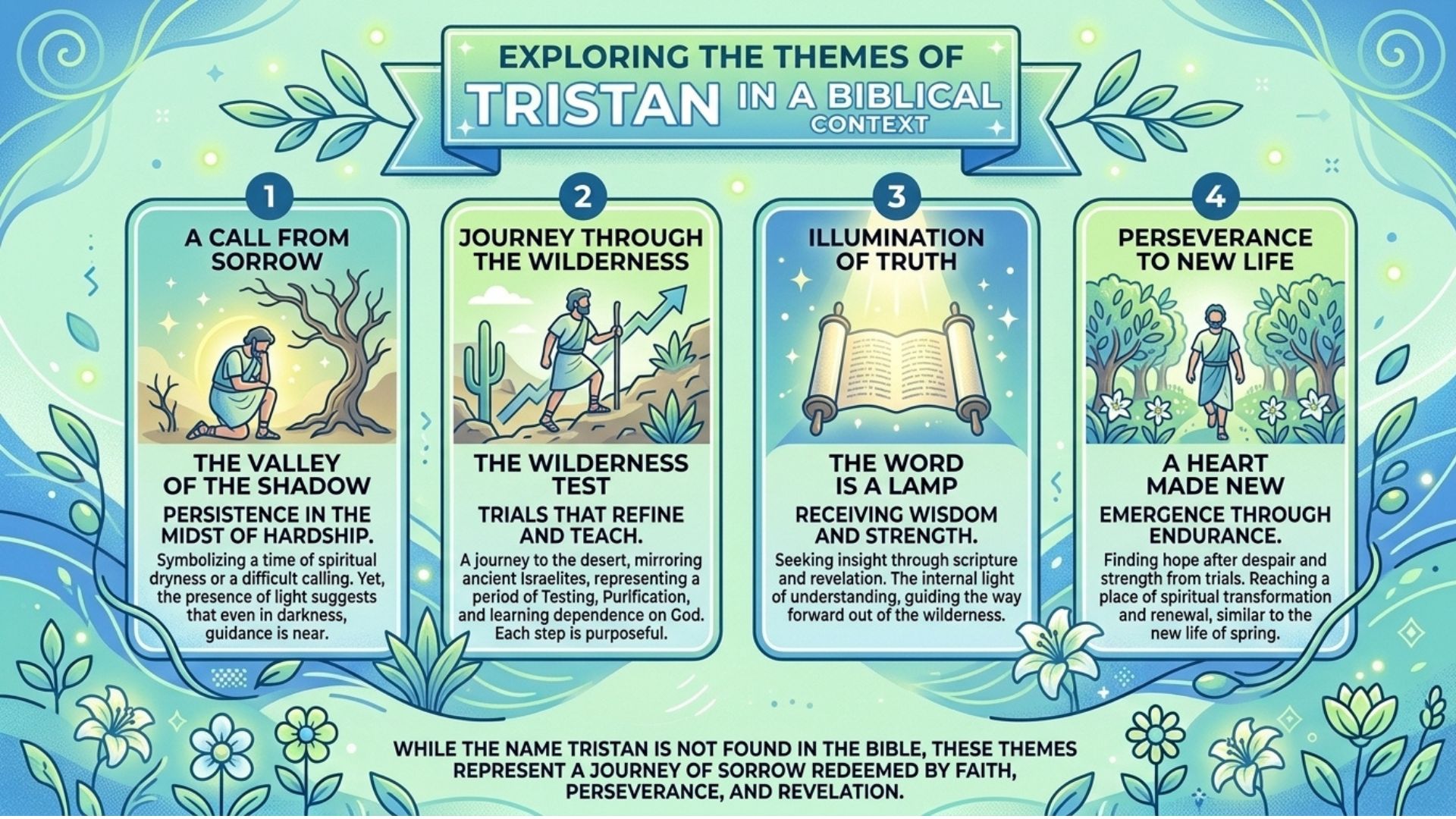
Tristan in the Bible: The Powerful Meaning Behind the Name
You typed “Tristan in the Bible” into a search bar for a reason, and honestly, that reason probably matters more than you’re giving it credit for. Maybe a baby is coming. Maybe a name keeps surfacing in your thoughts, or in a dream, and you can’t quite shake it.
Here’s the good news: this article walks through the Tristan name meaning Bible angle with real Scripture, honest history, and spiritual context not vague guesses. By the end, you’ll understand exactly where this name comes from, what it means through a biblical lens, and why that meaning might matter more to your life than you expected. Keep reading.
Tristan in the Bible

Straight answer first: Tristan in the Bible does not appear anywhere in Scripture. It isn’t in the Old Testament genealogies, and it isn’t in the New Testament letters either.
That single fact surprises a lot of people who assumed otherwise, but it doesn’t erase the name’s spiritual weight. Entities connected to this name sorrow, resilience, transformation show up constantly across biblical narrative, even without the exact word “Tristan” printed on a page.
Here’s what you should know before going further:
- Absent from every book of the Old and New Testament
- Not a Hebrew, Greek, or Aramaic biblical term
- Rooted instead in Old Celtic and Old French tradition
- Connected spiritually to themes of grief and comfort
- Popularized through medieval legend, not Scripture
- Meaningful anyway, when read through a biblical lens
Is Tristan Mentioned Anywhere in Scripture at All?
No verse, genealogy, or parable names anyone Tristan the connection to the Bible is thematic, not literal, and that distinction matters.
That said, plenty of readers ask this because so many familiar names carry obvious scriptural roots Daniel, Sarah, Elijah and it feels natural to expect the same here. The difference is that Tristan in the Bible works through meaning, not a direct mention. Scripture is full of names that function as declarations Abraham means “father of many,” Israel means “wrestles with God” and while Tristan wasn’t written into that tradition, its emotional core still sits comfortably beside it.
Example in conversation: Friend 1: “Wait, is Tristan actually in the Bible?” Friend 2: “Nope, not literally but its meaning lines up with a lot of biblical themes about sorrow and healing.”
What Does the Name Tristan Mean?

The name Tristan traces back to Old Celtic and Old French roots, tied closely to the word triste, meaning sorrowful or emotionally deep. It gained lasting fame through the medieval legend of Tristan and Isolde, a story of loyalty and sacrifice.
But the meaning stretches well past sadness. People carrying this name are frequently described as:
- Sensitive to the emotions of people around them
- Loyal in relationships, sometimes to a fault
- Resilient when life gets genuinely hard
- Compassionate toward anyone who is hurting
- Reflective, often processing life deeply before speaking
- Strong-willed, even beneath a quiet exterior
| Origin Element | Meaning |
| Old Celtic root | Sorrow, tumult, or noise |
| Old French triste | Sad, sorrowful |
| Legendary association | Tristan and Isolde |
| Modern interpretation | Emotional depth, resilience |
What’s interesting is how the name’s meaning shifted over centuries. In its earliest Celtic form, it leaned toward “tumult” or “noise” almost a description of inner emotional storms. By the time French troubadours told the story of Tristan and Isolde, the meaning had settled firmly into “sorrowful,” tied to a tragic, devoted love. Modern usage has softened that further, landing on a name that suggests emotional intelligence more than literal sadness. That evolution matters for anyone researching Tristan name meaning Bible connections, because it shows the name was never meant to be a life sentence of grief it was always describing a kind of person, not a permanent condition.
Tristan Name Origin and History
Long before it became a nursery favorite, Tristan carried centuries of storytelling weight, and understanding that backstory adds real texture to the name’s spiritual meaning today.
The name likely descends from the Pictish name Drustan, later blended with the French triste through Arthurian romance. Key historical touchpoints include:
- Medieval origin in Celtic Britain and Brittany
- Popularized by 12th-century Arthurian legend
- Merged with French sorrow-related vocabulary over time
- Revived in the 20th century as a modern given name
- Recognized today across English, French, and German-speaking cultures
How Did Tristan Become a Popular Christian Baby Name?
Its rise in Christian households owes less to Scripture and more to the name’s emotional honesty, which many parents find spiritually appealing.
It also helps that Tristan sounds distinctly modern while still carrying centuries of literary weight. Parents searching for something outside the usual pool of biblical names Noah, Elijah, Isaiah often land on Tristan because it feels fresh without feeling disconnected from meaning. Add in the growing trend of researching a name’s spiritual symbolism before choosing it, and it’s easy to see why so many Christian parents now search Tristan name meaning Bible before making a final decision for their child.
Is Tristan a Biblical Name?
Let’s stay honest here Tristan is not a biblical name in the strict sense, and no serious source will tell you otherwise.
You won’t find it in the Old Testament, the New Testament, or the Apocrypha. It isn’t Hebrew, Greek, or Aramaic. Still, that absence doesn’t disqualify it spiritually. Names like Emily, Nathan, and Grace share the same story non-biblical origin, biblical resonance.
- Zero direct scriptural mentions
- No Hebrew or Greek linguistic root
- Comparable to other beloved non-biblical Christian names
- Judged spiritually by meaning, not by appearance in text
- Compatible with a Christian identity regardless of origin
- Common among modern Christian parents today
Tristan meaning in hebrew
Tristan carries no direct Hebrew root, but Hebrew biblical thought still offers a meaningful framework for understanding what the name represents spiritually.
Hebrew concepts of sorrow like yagon (grief) and tza’ar (distress) aren’t treated as shameful in Scripture. They’re treated as honest, even sacred, expressions brought openly before God.
- Yagon (יָגוֹן) deep grief or anguish
- Tza’ar (צַעַר) pain or distress
- Psalms overflowing with raw, honest emotion
- David’s own laments modeling honest prayer
- Refinement imagery tied to fire and gold
- Restoration promised after seasons of sorrow
Tristan name meaning hebrew
Even without an actual Hebrew translation, the Tristan name meaning Bible search often leads people toward Hebrew wisdom literature for good reason it speaks directly to sorrow and healing.
The Psalms model exactly what a name like Tristan represents: bringing grief honestly before God rather than hiding it. That practice, deeply Hebrew in nature, still shapes Christian prayer today.
- Honest lament as a form of worship
- Refinement through trial, not punishment
- David’s psalms as an emotional template
- Grief acknowledged, never dismissed
- Comfort promised to the brokenhearted
- Growth framed as the outcome of pain
Tristan name meaning bible
When you search Tristan name meaning Bible, you’re really asking whether sorrow has spiritual purpose and Scripture answers that question clearly and repeatedly, again and again.
The core meaning of Tristan is sorrow, and the Bible treats sorrow not as weakness but as a doorway to God’s nearness. Psalm 34:18 promises the Lord is close to the brokenhearted. Romans 8:18 promises present suffering is nothing compared to future glory.
| Bible Reference | Core Promise |
| Psalm 34:18 | God is near the brokenhearted |
| Romans 8:18 | Suffering gives way to glory |
| James 1:2-4 | Trials produce perseverance |
| Psalm 30:11 | Mourning turns to dancing |
What Does Tristan Mean in the Bible According to Scripture?
Biblically, sorrow tied to a name like Tristan is never permanent it’s positioned as the starting point of comfort, growth, and eventual joy.
Bible Verses About the Meaning of Tristan
While no verse names Tristan directly, several passages speak straight into the emotional territory this name represents, giving it genuine scriptural weight.
- “The Lord is close to the brokenhearted.” Psalm 34:18
- “Blessed are those who mourn.” Matthew 5:4
- “Jesus wept.” John 11:35
- “You turned my wailing into dancing.” Psalm 30:11
- “Perseverance must finish its work.” James 1:2-4
- “The God of all comfort.” 2 Corinthians 1:3-4
Tristan meaning in bible
Searching Tristan meaning in Bible context, people usually want reassurance proof that a name rooted in sorrow isn’t a burden but a beautifully redemptive identity.
Scripture consistently reframes sorrow as sacred ground. It’s where God draws closest, where compassion is formed, and where growth quietly begins, long before anyone notices it happening.
- Sacred ground, not shameful territory
- Nearness of God promised during grief
- Compassion formed through personal suffering
- Maturity produced by trials over time
- Joy promised as the eventual outcome
Tristan Name Meaning Bible: The Spiritual Connection
Viewed through Scripture, Tristan name meaning Bible becomes something powerful rather than heavy a name pointing toward redemption instead of despair.
The core root, sorrow, is treated in the Bible as sacred rather than shameful. Psalm 34:18 says God draws near the brokenhearted, transforming Tristan’s meaning from something to fear into something to trust.
- Redemptive, not hopeless, in biblical framing
- Rooted in honest emotional expression
- Anchored by God’s promised nearness
- Pointed toward eventual restoration
- Shared with major figures like David and Job
- Confirmed by Jesus’s own tears in John 11:35
Example in conversation: Friend 1: “I keep worrying Tristan sounds too sad for a baby name.” Friend 2: “Actually, biblically, sorrow leads somewhere good it’s not a negative thing at all.”
Biblical Themes Connected to the Name Tristan
Five major biblical threads connect directly to the emotional core of this name, each one giving it deeper spiritual texture worth understanding fully.
1. God Is Near in Sorrow Matthew 5:4 calls mourners blessed, because comfort is already on its way to them.
2. Pain Produces Growth James 1:2-4 frames trials as the training ground for perseverance and lasting spiritual maturity.
3. Compassion Is Born From Suffering 2 Corinthians 1:3-4 shows how personal pain becomes fuel for comforting others later.
4. Jesus Himself Wept John 11:35 proves grief isn’t a faith failure; even the Son of God felt it fully.
5. Mourning Turns to Dancing Psalm 30:11 promises sorrow is temporary, always giving way to eventual restored joy.
| Theme | Scripture | Meaning for Tristan |
| Nearness in sorrow | Matthew 5:4 | Comfort follows mourning |
| Growth through pain | James 1:2-4 | Trials build maturity |
| Compassion from suffering | 2 Corinthians 1:3-4 | Pain becomes purpose |
| Honest grief | John 11:35 | Tears aren’t weakness |
| Joy after mourning | Psalm 30:11 | Sorrow always ends |
Taken together, these five themes form a complete arc rather than five separate ideas. Scripture doesn’t just say sorrow happens it says sorrow is noticed by God, used by God, and eventually replaced by God. That progression is exactly what gives Tristan name meaning Bible searches their emotional payoff. A name that starts in “sorrowful” ends, biblically speaking, in comfort, maturity, compassion, honesty, and joy. Few names carry that complete a spiritual journey packed into a single word.
What Is the Spiritual Meaning of Tristan in Christianity?
Christians researching this name typically want one thing confirmed that emotional depth and sorrow can coexist with genuine spiritual strength and purpose.
In Christian thought, sorrow isn’t the opposite of faith; it’s often the very place faith deepens most. That reframes Tristan as a name of resilience rather than sadness.
- Faith and grief coexisting without contradiction
- Sorrow reframed as spiritual training ground
- Compassion listed among genuine spiritual gifts
- Endurance modeled by biblical figures like Job
- Hope anchoring every mention of mourning in Scripture
What Does Tristan Mean in the Bible for Your Life?
Whether the name belongs to you, your child, or someone close to your heart, its biblical meaning carries real encouragement for daily faith and identity.
Here’s what it can represent personally:
- You feel deeply, and that sensitivity is a spiritual gift, not a flaw
- You may walk hard seasons, but those seasons signal growth, not abandonment
- You are positioned to comfort others because you’ve walked through real pain yourself
- Your sorrow has an expiration date restoration is God’s consistent promise
- You reflect biblical figures like David, Job, and Joseph who suffered before purpose
- You carry permission to bring raw emotion honestly before God in prayer
How Can Understanding Tristan’s Meaning Strengthen Your Faith?
Recognizing that sorrow has divine purpose helps reframe personal struggle as formation instead of failure, which is a genuinely freeing perspective.
Numerology and Symbolic Meaning of Tristan
Beyond Scripture, many parents also research the symbolic and numerological weight behind Tristan, curious whether it lines up with the name’s biblical themes too.
In numerology, Tristan is commonly associated with the number 7, symbolizing introspection, spiritual depth, and inner wisdom themes that echo its biblical connection to sorrow and growth.
- Number 7 associated with introspection and depth
- Symbolic of a searching, reflective personality
- Aligned with spiritual seekers and thinkers
- Echoed in biblical numerology around completeness
- Interpreted by some as a sign of quiet resilience
Tristan in Dreams: What Could It Mean?
Some people land here after hearing the name Tristan in a dream, wondering if it carries a spiritual message worth paying closer attention to.
In Christian dream interpretation, names often symbolize a current season or a gentle nudge from God rather than a literal prediction.
If the dream felt warm or peaceful, it may point to:
- Healing quietly beginning in a difficult season
- Affirmation of your emotional or spiritual journey
- Restoration approaching after a hard stretch
If the dream felt heavy or unsettled, it may point to:
- Invitation to bring hidden grief honestly to God
- Prompt toward deeper spiritual honesty in prayer
- Reminder that God remains present in difficulty
Example in conversation: Friend 1: “I dreamed about someone named Tristan last night, is that meaningful?” Friend 2: “Could be in Christian dream interpretation, names often point to healing or a season of change.”
Christian dream interpretation rarely works like a fixed dictionary. The same dream can mean different things depending on your current circumstances and what’s genuinely weighing on your heart. If the name Tristan keeps resurfacing in dreams, conversations, or quiet thoughts it’s reasonable to treat that as an invitation to bring it directly to God in prayer, asking what He’s saying, rather than searching for a single universal answer.
Why Do Christian Parents Choose the Name Tristan?
Parents drawn to this name often cite its emotional honesty and biblical resonance, even knowing it never technically appears in Scripture itself.
- Depth of character implied by the name’s meaning
- Story of loyalty tied to Tristan and Isolde
- Compatibility with biblical themes of growth through trial
- Uniqueness compared to more common biblical names
- Sound and rhythm many parents simply love
Is Tristan a Good Name for a Christian Baby?
This question comes up constantly in Tristan name meaning Bible searches, and the honest answer is a confident yes, for several solid reasons.
It carries themes of emotional depth, spiritual growth, and transformation all deeply biblical values. Figures like Job, David, Joseph, Ruth, and Paul all suffered before stepping into purpose.
- Meaningful even without direct scriptural origin
- Aligned with biblical stories of suffering and purpose
- Distinctive without feeling disconnected from faith
- Paired well with a middle name carrying scriptural roots
- Strengthened further through dedicated prayer over the child
Many Christian parents choose to pair Tristan with a strongly biblical middle name something like Tristan James, Tristan Elias, or Tristan Micah to balance the name’s Celtic origin with an unmistakable scriptural anchor. That pairing isn’t required, but it’s a popular way to give a child both a distinctive first name and a middle name rooted directly in Scripture. Some families also choose a dedication verse tied to the child’s name, often Psalm 34:18 or Romans 8:18, praying it over the baby during baptism or a dedication ceremony as a spoken blessing over their life.
Tristan Name Popularity Among Christian Families
Naming trends shift constantly, and Tristan has held steady popularity among Christian families for reasons that go beyond simple sound preference.
| Decade | General Popularity Trend |
| 1990s | Rising steadily in Western countries |
| 2000s | Entered top 100 names in several regions |
| 2010s | Popular in Christian and general naming lists |
| 2020s | Remains a stable, moderately popular choice |
- Steady ranking across the last three decades
- Common across US, UK, and Australian Christian communities
- Frequently paired with strong biblical middle names
- Chosen for its emotional and literary depth
How Does the Bible View the Meaning of Sorrow Behind Tristan?
Scripture never treats sorrow as failure it treats it as raw material God consistently uses to build compassion, maturity, and lasting spiritual strength.
- Sorrow acknowledged honestly throughout the Psalms
- Weeping modeled directly by Jesus in John 11:35
- Trials transformed into perseverance through James 1
- Comfort promised specifically to the brokenhearted
- Joy guaranteed as sorrow’s ultimate outcome
Spiritual Lessons From the Meaning of Tristan
Gathering the key biblical takeaways from this name makes them genuinely practical for everyday faith, not just theoretical or academic reflection.
- God is always near in sorrow you are never abandoned in grief
- Pain has divine purpose nothing walked through is wasted in God’s hands
- Emotional depth is strength people who feel deeply also pray deeply
- Compassion grows through difficulty your trials prepare you to serve others
- Sorrow is temporary joy comes as God’s consistent promise, not wishful thinking
- Honest prayer matters bring real emotions to God; He can handle them
- Faith isn’t tearless even Jesus wept, and that never disqualified His faith
Put together, these lessons form a kind of quiet spiritual roadmap not just for someone named Tristan, but for anyone walking through a hard season right now. Scripture never asks you to fake strength or hide sorrow. It simply asks you to bring it honestly to God, trusting that the same hands that turned mourning into dancing for the psalmist are still doing that same work today, in ordinary lives, in ordinary seasons, one honest prayer at a time.
Frequently Asked Questions
Is Tristan a biblical name?
No, Tristan in the Bible doesn’t appear anywhere. Its meaning still connects strongly to biblical themes like sorrow, endurance, and restoration.
What does Tristan mean spiritually?
Spiritually, it represents emotional depth, compassion shaped by personal pain, and faith that grows stronger through genuinely difficult seasons.
Is Tristan in the Bible?
There’s no person named Tristan in Scripture, but the values behind its meaning mirror central biblical teaching on suffering and growth.
Is Tristan a good name for a Christian?
Yes. While not originally biblical, Tristan name meaning Bible research shows it aligns beautifully with Christian character and spiritual growth.
What does dreaming of the name Tristan mean?
It may reflect a season of healing, a call to deeper prayer, or God’s reminder of nearness during emotional difficulty.
What does Tristan mean in Hebrew?
Tristan isn’t Hebrew, but Hebrew biblical thought connects it to honest grief before God and spiritual refinement through trials.
Why is Tristan associated with sorrow in the Bible?
The name’s root meaning is sorrow, and Tristan in the Bible themes consistently show sorrow as a doorway to comfort, not despair.
Conclusion
Tristan in the Bible was never going to be a literal find, but the search itself uncovered something better a name loaded with real spiritual meaning. The Tristan name meaning Bible connection isn’t about a verse; it’s about sorrow reframed as sacred ground where God draws close.
Through Psalm 34:18, Romans 8:18, and the tears of Jesus in John 11:35, Scripture shows that a name rooted in sorrow can still carry hope, resilience, and eventual joy. Whether this name belongs to you, your child, or a season you’re walking through, Tristan in the Bible points toward one clear truth: mourning always turns to dancing eventually.
If this name has touched your heart, bring it to God in prayer and ask what He’s saying through it. He is always near, and He never wastes a single tear.

Samuel Prescott explores Bible meanings, biblical names, and scripture insights, helping readers uncover deeper faith and understanding.